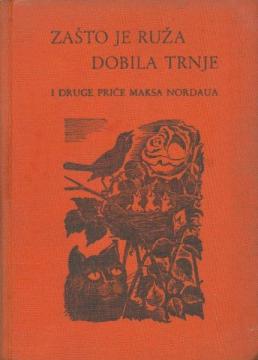
Zašto je ruža dobila trnje i druge priče Maksa Nordaua
Antique
Rare book

Zašto je ruža dobila trnje i druge priče Maksa Nordaua

Max Nordau
Translation
Mirjama Bencević, Aleksa Bencević
Editor
Mirjama Bencević, Aleksa Bencević
Dimensions
20 x 14 cm
Pages
108
Publisher
Samizdat, Zagreb, 1936.
 
Latin alphabet. Hardcover.
Language: Croatian.

One copy is available

Condition:Used, good condition (visible signs of use)
Damages or inconvenience notice:
  • Traces of patina
  • Slight damage to the pages
  • Slight damage to the cover
 

Are you interested in another book? You can search the offer using our search engine or browse books by category.

You may also be interested in these titles

Crni ljepotan

Crni ljepotan

Anne Sewell

At a time when he peacefully grazed the lush grass next to his mother in his native green valley, the beautiful young stallion, Black Beauty, could not even dream of all the adventures that would befall him in the future.

Svjetlost, 1972.
Croatian. Latin alphabet. Hardcover.
2.98
Tajna šaptača lubenicama

Tajna šaptača lubenicama

Hrvoje Kovačević

Elderly, mobility-impaired patients begin to mysteriously disappear from the Special Hospital for Medical Rehabilitation in Stubičke Toplice.

Znanje, 2008.
Croatian. Latin alphabet. Hardcover.
7.98
Družba Sinjega Galeba

Družba Sinjega Galeba

Tone Seliškar

The plot depicts adventures during which he will clash with a gang of smugglers.

Svjetlost, 1975.
Croatian. Latin alphabet. Hardcover.
2.82
Seme trave

Seme trave

Kornelija Šenfeld Oljača
Svjetlost, 1976.
Croatian. Latin alphabet. Hardcover.
2.72
Bosonogo djetinjstvo

Bosonogo djetinjstvo

Branko Ćopić

The work brings together a gallery of colorful characters – family members, village neighbors, teachers, friends – who shape Ćopić's childish view of the world.

Svjetlost, 1976.
Croatian. Latin alphabet. Hardcover.
3.48
Delije na Bihaću

Delije na Bihaću

Branko Ćopić

Delije na Bihać is a humorous story by Branko Ćopić in which the author describes the adventures and misadventures of young village men – "delija" – who go to Bihać, then a larger and more important urban center.

Svjetlost, 1976.
Croatian. Latin alphabet. Hardcover.
2.74