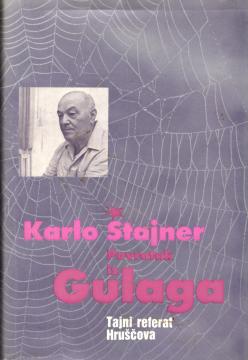
Povratak iz Gulaga: Tajni referat Hruščova

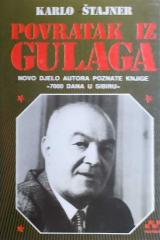
Povratak iz Gulaga: Tajni referat Hruščova

Karlo Štajner

A sequel to his memoir 7000 Days in Siberia, in which he describes his twenty-year imprisonment in Soviet gulags. The book delves into his experiences in the camps, providing additional insights into Steiner's life and reflections on communist ideals.

Steiner, an Austrian communist, came to the USSR in 1932, believing in a socialist paradise. In 1936, during Stalin's purges, he was arrested under the false accusation of being a "Gestapo agent". In the book, he describes the brutal conditions of the camp, from the Solovetsky Islands to Siberia, and the strategies for survival. He records in detail the daily life of the camp: work in extreme conditions, hunger, fear, but also small moments of solidarity. He particularly emphasizes the role of his wife, Sonya, who faithfully waited for him.

The book also deals with Steiner's encounters with people who participated in the atrocities, but also became victims themselves. It explores the moral issues of communism, especially after Khrushchev's report on Stalin's cult of personality. Despite his suffering, Steiner remains faithful to communist ideals, which distinguishes him from authors like Solzhenitsyn, whose anti-communism he despises.

Return from the Gulag is a testimony to the resilience of the spirit, but also a warning about the dangers of totalitarianism.

Graphics design
Bronislav Fajon
Dimensions
24 x 17 cm
Pages
345
Publisher
Globus, Zagreb, 1986.
 
Latin alphabet. Hardcover with dust jacket.
Language: Croatian.

Two copies are available

Copy number 1

Condition:Used, excellent condition

Copy number 2

Condition:Used, excellent condition
 

Are you interested in another book? You can search the offer using our search engine or browse books by category.

You may also be interested in these titles

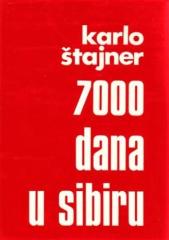
7000 dana u Sibiru

7000 dana u Sibiru

Karlo Štajner

Steiner spent twenty years in the most terrible camps in the expanses of Siberia, and in this book he presents the testimonies of the terrible crimes committed by Stalin in the name of communism.

Globus, 1982.
Croatian. Latin alphabet. Hardcover with dust jacket.
14.26
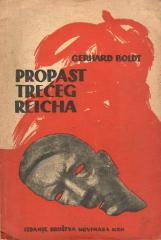
Propast Trećeg Reicha: Posljednji dani kancelarije Reicha

Propast Trećeg Reicha: Posljednji dani kancelarije Reicha

Gerhard Boldt

Diary testimony of an officer from the Eastern Front and Berlin in 1945: the collapse of command, the chaos of defense, the illusions and reality of the last days of the Third Reich, told coldly, precisely, firsthand.

Društvo novinara NR Hrvatske, 1952.
Croatian. Latin alphabet. Paperback.
11.24
Izabrani radovi

Izabrani radovi

Ljubo Boban

Selected Works of Academician Ljubo Boban (2022) brings together key texts on contemporary Croatian history of the 20th century. The foreword by Damir Agičić highlights Boban's methodological rigor and objectivity in researching sensitive topics.

Srednja Europa, 2022.
Croatian. Latin alphabet. Hardcover.
24.52
Metamorfoze Ruskog Carstva 1721. - 1921.: Geopolitika, ode i narodi

Metamorfoze Ruskog Carstva 1721. - 1921.: Geopolitika, ode i narodi

Andrzej Nowak

A historical study of the transformations of the Russian Empire from Peter the Great to the early USSR, focusing on imperial geopolitics, ideological patterns, and relations with peoples within the empire.

Fortuna d.o.o., 2023.
Croatian. Latin alphabet. Hardcover.
35.00
Žene Italije

Žene Italije

Maria Castellani

An overview of the history and position of Italian women from antiquity to Mussolini's fascist Italy, with an emphasis on their contribution to society and culture. A popular educational publication from the period of the Independent State of Croatia, wit

Società Editrice di Novissima, 1941.
Croatian. Latin alphabet. Paperback.
13.24
Sudbonosni podvig Jugoslavije: Podsjećanje na historijsko NE staljinizmu, događaj koji je opredijelio budućnost Jugoslavije

Sudbonosni podvig Jugoslavije: Podsjećanje na historijsko NE staljinizmu, događaj koji je opredijelio budućnost Jugoslavije

Raif Dizdarević

The book by Raif Dizdarević, one of the last living actors of Yugoslav diplomacy, presents his reconstruction of the most fateful moment of post-war Yugoslavia – the split with Stalin and the Informburo in 1948–1953.

Udruženje za modernu historiju (UMHIS), 2018.
Croatian. Latin alphabet. Paperback.
23.58