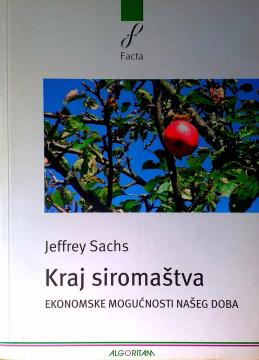
Kraj siromaštva: Ekonomske mogućnosti našeg doba

Kraj siromaštva: Ekonomske mogućnosti našeg doba

Jeffrey Sachs

In the book, economist Jeffrey Sachs presents an optimistic plan for eliminating extreme poverty by 2025. He argues that this is feasible with political will, because world wealth is growing, and poverty is not fate, but the result of inefficient systems.

Sachs introduces "clinical economics" - a systematic approach to treating a disease: diagnosis of the problem, prescription (interventions), and monitoring. He focuses on the poorest countries in Africa, Asia, and Latin America, where billions of people live on less than $1 a day. Key causes: geographical barriers (tropical diseases, droughts), lack of investment in infrastructure, education, and health, and political instability.

He proposes a three-pronged plan: (1) Urgent aid for the "big fight" - networks for malaria prevention, AIDS, distribution of seeds and fertilizers for agriculture; (2) Long-term development - building roads, schools, clinics; (3) Global cooperation - increasing support from rich countries to 0.7% of GDP for development aid, debt cancellation, and non-discriminatory trade rules.

The book is replete with case studies: Sachs's success in Bolivia (1985, hyperinflation stopped), Poland (shock therapy), and Zambia (malaria controlled). He criticizes the West for ineffective aid and calls for support for the Millennium Development Goals of the UN. It concludes that poverty is not inevitable – with $175 billion a year (less than 1% of global GDP) we can save lives, prevent wars and boost growth.

Sachs's vision is inspiring, but critics warn of the risks of dependence on aid. Nevertheless, the book remains a manifesto of humanism in economics.

Original title
The End of Poverty: Economic Possibilities for Our Time
Translation
Nebojša Buđanovac
Editor
Irena Miličić
Dimensions
23 x 17 cm
Pages
450
Publisher
Algoritam, Zagreb, 2007.
 
Latin alphabet. Paperback.
Language: Croatian.

One copy is available

Condition:Used, excellent condition
 

Are you interested in another book? You can search the offer using our search engine or browse books by category.

You may also be interested in these titles

Kaotika

Kaotika

Philip Kotler, John A. Caslione

Management and Marketing in Turbulent Times. An indispensable guide for business leaders who strive to survive today's economic storms and thrive in tomorrow's inevitable turbulence.

Mate d.o.o, 2009.
Croatian. Latin alphabet. Paperback with dust jacket.
5.24
Novac i plaćanja

Novac i plaćanja

Krešimir Vrsaljko
Narodne novine, 1973.
Croatian. Latin alphabet. Hardcover.
9.99
Poduzetništvo: realnost sadašnjosti i izazov budućnosti

Poduzetništvo: realnost sadašnjosti i izazov budućnosti

Marin Buble, Dejan Kružić

In sechs Kapiteln geht der Autor auf aktuelle Probleme und Perspektiven der Entwicklung von Unternehmertum und Kleinunternehmen ein.

RRiF-plus, 2006.
Croatian. Latin alphabet. Paperback.
7.98
Strani privatni kapital i razvoj nerazvijenih zemalja - Neka iskustva Azije

Strani privatni kapital i razvoj nerazvijenih zemalja - Neka iskustva Azije

Blagoje S. Babić

The book explores the role of foreign capital in the development of underdeveloped countries. This book studies experiences from Asia and analyzes how foreign capital can contribute to economic progress.

Institut za međunarodnu politiku i privredu, 1982.
Serbian. Latin alphabet. Hardcover with dust jacket.
9.98
Financijska tržišta i institucije

Financijska tržišta i institucije

Frederic S. Mishkin, Stanley G. Eakins

"Financial Markets and Institutions" by Frederic S. Mishkin and Stanley G. Eakins (2005 edition) provides a comprehensive overview of financial systems, exploring the role of financial markets, institutions, and instruments in the economy.

Mate d.o.o, 2005.
Croatian. Latin alphabet. Paperback.
31.48
Dugovi stvarnost i mit

Dugovi stvarnost i mit

George Macesich
August Cesarec, 1987.
Croatian. Latin alphabet. Paperback.
6.98