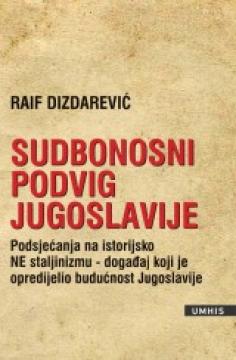
Sudbonosni podvig Jugoslavije: Podsjećanje na historijsko NE staljinizmu, događaj koji je opredijelio budućnost Jugoslavije
Rare book

Sudbonosni podvig Jugoslavije: Podsjećanje na historijsko NE staljinizmu, događaj koji je opredijelio budućnost Jugoslavije

Raif Dizdarević

The book by Raif Dizdarević, one of the last living actors of Yugoslav diplomacy, presents his reconstruction of the most fateful moment of post-war Yugoslavia – the split with Stalin and the Informburo in 1948–1953.

The author describes in detail the genesis of the conflict: from the first disagreements in 1945–1947 (military aid, Balkan Federation, Trieste Question) to the final letter of the Central Committee of the Communist Party of Yugoslavia of March 27, 1948, and the Resolution of the Inform Bureau (June 28, 1948). He particularly emphasizes the internal struggle within the leadership of the Communist Party of Yugoslavia: how Tito, along with Kardelj, Đilas, and Ranković, decided not to submit to Stalin, even though the USSR was the liberator and main support.

The central part of the book consists of the dramatic events of 1948–1949:

  • massive pressure from the Eastern Bloc (economic blockade, withdrawal of experts, border incidents)
  • arrests and trials of Ibe members (Dizdarević provides new data on the number of victims and torture on Goli Otok)
  • secret negotiations with the Americans and British (first contacts through Robert Joyce and the Yugoslav embassy in London)
  • emergence of the "Third Way" doctrine and the Law on Self-Management (1950) as a response to Soviet statism

Dizdarević argues that Stalin's "NO" was crucial for the survival of Yugoslavia: without this act, the country would have become a Soviet province like Hungary or Bulgaria. The book ends with the assessment that this feat enabled non-alignment and relative freedom, but also created a lasting trauma of repression against its own citizens.

The personal tone, previously unpublished documents and testimonies make the book the most complete domestic account of that period after Đilas and Dedier's memoirs.

Graphics design
Darko Skert
Dimensions
25 x 17 cm
Pages
230
Publisher
Udruženje za modernu historiju (UMHIS), Sarajevo, 2018.
 
Latin alphabet. Paperback.
Language: Croatian.

One copy is available

Condition:Used, excellent condition
 

Are you interested in another book? You can search the offer using our search engine or browse books by category.

You may also be interested in these titles

Filozofija revolucije

Filozofija revolucije

Gamal Abdel Nasser

G. A. Nasser's Philosophy of Revolution is a political manifesto and ideological program of the Egyptian Revolution of 1952. In it, Nasser explains the motives of the revolution, the role of Egypt in the Arab and African world, and the vision of Arab nati

Džepna knjiga, 1956.
Serbian. Latin alphabet. Paperback.
9.56
Hitler osvajač: raskrinkavanje jedne legende

Hitler osvajač: raskrinkavanje jedne legende

Rudolf Olden

One of the first anti-Hitler works, published by Nolit as early as 1933. This is an early, shorter version of the work (originally published anonymously in Prague), which preceded the expanded edition from Amsterdam in 1935.

Nolit, 1933.
Croatian. Latin alphabet. Hardcover with dust jacket.
15.32
Bitka za Moskvu

Bitka za Moskvu

Branko Kitanović

The Battle of Moscow is a historical account of the German Operation "Barbarossa", the Soviet defense and counteroffensive in 1941. The author, with the testimonies of the top Soviet military leaders, shows how the first German defeat in the war unfolded.

Alfa, 1975.
Croatian. Latin alphabet. Hardcover with dust jacket.
7.96
Bormannova braća idu dalje

Bormannova braća idu dalje

William Stevenson

The book reveals the secret network through which Martin Bormann, Hitler's treasurer, ensured the survival of Nazi power and capital after the fall of the Third Reich.

Vjesnik, 1977.
Croatian. Latin alphabet. Hardcover.
6.54
Adolf Hitler - Führer Trećega Reicha

Adolf Hitler - Führer Trećega Reicha

Joan Solé

In the book, Joan Solé shows the life, ideology and rise of Adolf Hitler. The book explores how a charismatic but fanatical leader shaped a totalitarian regime and plunged the world into one of the most tragic wars in history.

Twins Company d.o.o., 2025.
Croatian. Latin alphabet. Paperback.
8.56
Ilustrirana povijest svijeta: Od 1945. do Hladnog rata

Ilustrirana povijest svijeta: Od 1945. do Hladnog rata

Neil Morris

The book explains how, after 1945, the world was divided into two opposing blocs: the Western (led by the USA) and the Eastern (led by the Soviet Union).

24 sata, 2011.
Croatian. Latin alphabet. Hardcover.
5.00