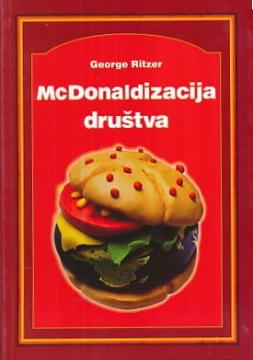
McDonaldizacija društva
The book has become a classic because it accurately describes the world of Amazon, Uber, Netflix, and TikTok thirty years in advance. Ritzer does not curse fast food, but warns that if the whole of society turns into McDonald’s, we will remain full but hu
In this cult book, George Ritzer, an American sociologist, argues that modern society is not developing towards postmodernism or the information age, but towards the model first perfected by McDonald’s. He calls this model McDonaldization and defines it as the process in which the principles of fast food become the dominant way of organizing almost all spheres of life.
The book draws on Max Weber and his thesis on rationalization and the “iron cage” of bureaucracy, but Ritzer goes a step further: today’s rationality is not bureaucratic, but fast-food rationality, based on four pillars:
- Efficiency – optimizing the process to get from need to satisfaction as quickly as possible (drive-thru, self-scanning in stores, online orders, ready-meals).
- Calculability – everything is measured in numbers: time, quantity, price. Quality is secondary (“30 seconds or it’s free”, 5-minute YouTube tutorials, 15-minute doctor’s appointments).
- Predictability – the user always gets the same experience, without surprises (same menu in 120 countries, same store design, same playlist at Starbucks).
- Control – people are replaced by technology or strictly scripted (robots in Amazon warehouses, "smile number 7" of employees, algorithms that decide what to watch).
Ritzer also introduces the fifth, most dangerous consequence - the irrationality of a rational system: seemingly perfect efficiency creates enormous damage. There are "McJobs" (dull work with no future), "McUniversities" (massive teaching, MOOCs, rankings), "McHospitals" (15 minutes per patient), and even "McSex" (Tinder, fast and standardized).
In later editions (2004, 2011, 2018), Ritzer shows how the process has accelerated: Amazon, Uber, Netflix, Instagram, and TikTok are perfect examples of “McDonaldization 2.0,” where the user exploits himself (delivers, rates, creates content for free). The book ends with a warning: if we don’t resist, our whole life will become a giant drive-thru—fast, cheap, tasty at first, but ultimately empty and soulless.
And thirty years later, this is the most accurate diagnosis of the world we live in.
One copy is available