Otisci bogova: Potraga za početkom i krajem

Otisci bogova: Potraga za početkom i krajem

Graham Hancock
Hancock

Hancock's evidence reveals not only the clear footprints of an unknown civilization that flourished during the last ice age, but also the terrifying truth about the scale of the catastrophe that wiped out almost all traces of it.

Hancock claims that 12,000–15,000 years ago there was an advanced global civilization ("lost mother-culture") that possessed knowledge of astronomy, mathematics, navigation, and construction superior to that of today. This civilization was destroyed in a catastrophic global flood caused by the shifting of the Earth's crust and the melting of glaciers at the end of the last ice age (~10,900 BC).

The surviving "gods" (white-skinned, bearded teachers) brought knowledge to the surviving hunter-gatherers and launched all later civilizations: Egypt, Sumer, Mesoamerica, Peru, and even India and China.

Evidence:

  • Maps by Piri Reis (1513) and Oronteus Finae (1531) show Antarctica free of ice, which was only possible 12,000 years ago.

  • The Sphinx shows erosion from heavy rains (10,500–8000 BC), not desert sand.

  • The pyramids at Giza and Teotihuacán encode precise astronomical data and the ratio of π to φ.

  • Flood myths exist among 500 peoples of the world with identical details.

  • Goebekli Tepe in Turkey (9600 BC) shows sophisticated astronomy 7000 years before Sumer.

Hancock concludes that academic archaeology deliberately ignores this evidence because it would overthrow the official chronology. The book ends with a warning: the next catastrophe (the return of a comet or a pole shift) could happen already in our time.

The book has sold over 8 million copies, has become the bible of alternative history and has caused a lasting controversy with mainstream science.

Original title
Fingerprints of the Gods
Translation
Petra Štrok
Editor
Božica Cikuša, Zdravko Cikuša
Illustrations
Santha Faiia
Graphics design
Božica Cikuša
Dimensions
24 x 17 cm
Pages
531
Publisher
Stari grad, Zagreb, 2002.
 
Latin alphabet. Hardcover.
Language: Croatian.
ISBN
978-9-53671-620-3

Multiple copies are available

Copy number 1

Condition:New

Copy number 2

Condition:New

Copy number 3

Condition:New
Discounted price: 19.2815.42 €
20% discount is valid until 12/31/26 11:59 pm

Copy number 4

Condition:New
Discounted price: 19.2615.41 €
20% discount is valid until 12/31/26 11:59 pm
 

Are you interested in another book? You can search the offer using our search engine or browse books by category.

You may also be interested in these titles

Talisman: sveti gradovi, tajna vjera

Talisman: sveti gradovi, tajna vjera

Hancock, Bauval
Graham Hancock, Robert Bauval

Talisman je uzbudljivo intelektualno putovanje kroz skrivene ulice i podzemne kanale povijesti u potrazi za tragovima tajne religije koja je oblikovala svijet, skrivenima u arhitekturi i spomenicima.

Stari grad, 2006.
Croatian. Latin alphabet. Hardcover.
24.4217.09 - 24.4617.12 €
Izabrani Plinijevi listovi

Izabrani Plinijevi listovi

Plinije Stariji

Anthology of Latin Fragments of Pliny the Elder with Croatian Explanations (Golik, 1909) presents ancient views on nature, man and the world, with brief comments for understanding and teaching.

Troškom i nakladom Kr. hrv.-slav.-dalm. zemalj. vlade, 1909.
Latin. Latin alphabet. Paperback.
9.32 €
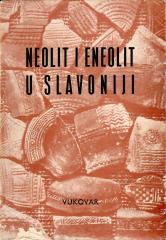
Neolit i eneolit u Slavoniji

Neolit i eneolit u Slavoniji

Stojan Dimitrijević, Bogdan Brukner, Nikola Tasić, Vladimir Mirosavljević

The proceedings of the Symposium "Neolithic and Eneolithic in Slavonia", held in Vukovar on 4–5 June 1966, bring together contributions on Neolithic and Eneolithic cultures, material finds and regional connections.

Gradski muzej Vukovar, 1969.
Croatian. Latin alphabet. Paperback with dust jacket.
13.54 €
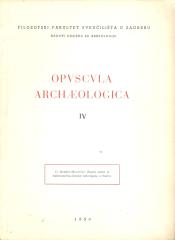
Opuscula archaeologica IV: Zlatni nakit iz helenističko-ilirske nekropole u Budvi

Opuscula archaeologica IV: Zlatni nakit iz helenističko-ilirske nekropole u Budvi

Duje Rendić-Miočević

The article presents a classic analysis of archaeological findings from the Hellenistic period (3rd-2nd century BC) in the necropolis north of ancient Budva (today's Montenegro), discovered in the 1950s.

Filozofski fakultet Sveučilišta u Zagrebu, 1959.
Croatian. Latin alphabet. Paperback.
9.36 €
Užasi povijesti: Pokvareni Rimljani

Užasi povijesti: Pokvareni Rimljani

Terry Deary

The corrupt Romans knew how to live... From the savage Nero to other disgusting emperors, from brave legionaries to poor farmers, the diversity and beauty of the terrible Roman era are amazing.

Egmont, 2011.
Croatian. Latin alphabet. Paperback.
6.36 €