Rosslyn i Gral

Rosslyn i Gral

Mark Oxbrow, Ian Robertson

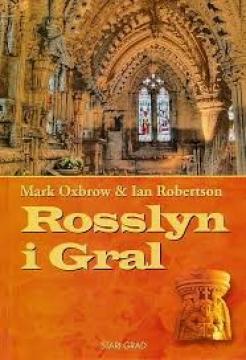
The book Rosslyn and the Grail by Scottish authors Mark Oxbrow and Ian Robertson is the most thorough and sobering work debunking the myths surrounding Rosslyn Chapel and its alleged connection to the Holy Grail and the Knights Templar.

The authors, a historian and archaeologist, systematically demystify claims from books such as The Holy Blood, The Holy Grail and The Da Vinci Code. They show that:

  • Rosslyn Chapel was not built in 1446–1486 for the Templars (the Order was abolished in 1312), but for the Sinclair family as a collegiate church;
  • there is no evidence that the Templars ever owned Rosslyn or the surrounding land;
  • the "secret symbols" (corn, aloe vera, three-dimensional cubes) are either later restorations (19th/20th centuries) or misinterpretations of ordinary biblical and Masonic motifs;
  • the alleged "cryptograms" and "coded messages" in the stone carvings do not exist when the original plans and photographs are examined.

The book features archival documents, old photographs before restoration and comparisons with similar Gothic churches. Although it shatters romantic myths, it does so with respect for the beauty of Rosslyn and leaves room for wonder at the skill of medieval stonemasons. The best "antidote" to sensationalist literature, and at the same time an excellent guide through the real history and architecture of one of Scotland's most beautiful chapels.

Original title
Rosslyn and the Grail
Translation
Vesna Valenčić
Editor
Božica Cikuša, Zdravko Cikuša
Graphics design
Zlatko Bilandžija
Dimensions
24 x 117 cm
Pages
232
Publisher
Stari grad, Zagreb, 2006.
 
Latin alphabet. Hardcover.
Language: Croatian.
ISBN
978-9-53671-647-0

Multiple copies are available

Copy number 1

Condition:New

Copy number 2

Condition:New

Copy number 3

Condition:New

Copy number 4

Condition:New
 

Are you interested in another book? You can search the offer using our search engine or browse books by category.

You may also be interested in these titles

Vitezovi Templari u Novome svijetu: Kako je Henry Sinclair donio Gral u Akadiju

Vitezovi Templari u Novome svijetu: Kako je Henry Sinclair donio Gral u Akadiju

William F. Mann

Almost a hundred years before Columbus discovered the New World, Scottish Prince Henry Sinclair sailed to what is now Nova Scotia. It was this same Prince Henry Sinclair who offered refuge to the Knights Templar, who were fleeing persecution by the French

Stari grad, 2004.
Croatian. Latin alphabet. Hardcover.
15.22 - 15.28
Hram i loža

Hram i loža

Michael Baigent, Richard Leigh

Although considered controversial by historians and often criticized as speculative and lacking solid evidence, the book is indispensable and extremely influential – it directly inspired Dan Brown's "The Da Vinci Code" and the entire genre of esoteric lit

Stari grad, 2005.
Croatian. Latin alphabet. Hardcover.
17.22 - 17.28
Robovlasništvo i diktatura u Rimskoj republici

Robovlasništvo i diktatura u Rimskoj republici

Pavao Pauš

The book deals with the analysis of socio-economic relations in the late Roman Republic, with particular emphasis on the slave system and the political power of the dictatorship.

Školska knjiga, 1956.
Croatian. Latin alphabet. Paperback.
7.28
Eseji i članci

Eseji i članci

Ljubo Karaman

The collection Essays and Articles by Ljubo Karaman, an eminent art historian, includes a series of texts on Croatian art, with an emphasis on the medieval heritage of Dalmatia and its connection with European cultural movements.

Matica hrvatska, 1939.
Croatian. Latin alphabet. Hardcover.
10.34
Ilustrirana povijest svijeta: Rani srednji vijek (907.-1154.)

Ilustrirana povijest svijeta: Rani srednji vijek (907.-1154.)

Karin Feuerstein-Praßer, Andrea Groß-Schulte, Marion Jung, Cornelia Lawrenz, Karin Prager, Otto S...

The fourth volume of Reader's Digest's "Illustrated History of the World" series, illustrated in color, intended for history buffs, provides an overview of key events and civilizational achievements around the world, in the period from 907 to 1154.

Mozaik knjiga, 2010.
Croatian. Latin alphabet. Hardcover.
11.56