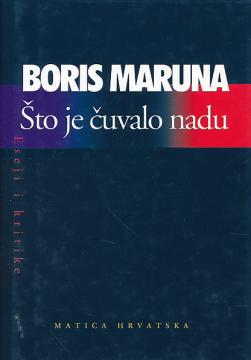
Što je čuvalo nadu

Što je čuvalo nadu

Boris Maruna

Boris Maruna, a poet and essayist, has carried the burden of a history that has been silenced and entrusted to myth since his early youth. He carried this burden in his poems, but also in his essayistic prose, which is brought together for the first time

These are texts that were written during his exile, as well as those published after his return to his homeland in 1991. With his own life, Maruna carried this historical burden with unusual courage and unpredictability, which makes his work even more valuable, because it was initially created in the spiritually retrograde environment of the post-war Croatian emigration, and later in the completely inverted value system of early post-communist Croatia. Maruna has always stood out from these worlds with a different voice... There is no doubt that Boris Maruna is one of the best Croatian poets who worked in emigration, and who fatefully intertwined his life with all his texts, regardless of whether they were verse or prose. Finally, in Croatian literature, no one has managed to connect the weight of historical and mythical space with the reality of his own life like him. And no one has created so many painfully accurate and lucid bridges between these separate worlds like Maruna.

Editor
Jelena Hekman
Graphics design
Luka Gusić
Dimensions
21 x 15 cm
Pages
486
Publisher
Matica hrvatska, Zagreb, 2008.
 
Latin alphabet. Hardcover with dust jacket.
Language: Croatian.

One copy is available

Condition:Used, excellent condition
 

Are you interested in another book? You can search the offer using our search engine or browse books by category.

You may also be interested in these titles

Otmičari ispunjena sna

Otmičari ispunjena sna

Boris Maruna

The book is part diary entries, part documentary reconstruction, with elements of memoir and political prose.

Mozaik knjiga, 1995.
Croatian. Latin alphabet. Paperback.
11.9610.76
An American Sickness: How Healthcare Became Big Business and How You Can Take It Back

An American Sickness: How Healthcare Became Big Business and How You Can Take It Back

Elisabeth Rosenthal

The book examines how the American health care system has become profit-oriented. The author examines various aspects of the healthcare industry and offers insights into how individuals can fight back against an unfair system.

Penguin books, 2017.
English. Latin alphabet. Paperback.
9.587.66
Najveće svetske nesreće dvadesetog veka

Najveće svetske nesreće dvadesetog veka

- A catastrophic fire in a super-luxury hotel in Las Vegas - The flood destroys the Renaissance treasure - Mysterious suffocation of all passengers in a crowded train - A deadly heat wave is sweeping America

Druga strana sveta, 1984.
Serbian. Latin alphabet. Hardcover.
5.98
Pogledajte, ovako su nas opljačkali Luka Bebić, Ivo Sanader, Jadranka Kosor, Zoran Milanović, Ivo Josipović, HDZ i Mladen Bajić

Pogledajte, ovako su nas opljačkali Luka Bebić, Ivo Sanader, Jadranka Kosor, Zoran Milanović, Ivo Josipović, HDZ i Mladen Bajić

Tomislav Dragun

4th evil: Fund for Homeland War Veterans and Their Family Members

Ognjište, 2011.
Croatian. Latin alphabet. Hardcover.
19.86
Sovjetska alternativa

Sovjetska alternativa

Drago Buvač

An essay on the scientific and technical revolution and the economic system of the USSR 1950-1975

Stvarnost, 1977.
Croatian. Latin alphabet. Paperback.
3.98
Kako su rušili HAZU?

Kako su rušili HAZU?

Josip Pečarić

The book How did they demolish HAZU? by Josip Pečarić, published in 2006, analyzes internal conflicts within the Croatian Academy of Sciences and Arts (HAZU).

Vlastita naklada, 2006.
Croatian. Latin alphabet. Paperback.
5.62