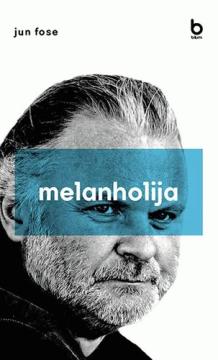
Melanholija 1-2

Melanholija 1-2

Jun Fose

Combining historical facts with fiction, the author draws us deep into the world of the artist's thin soul, whose vulnerability is caused by his tragic end, but who also possesses an incredible gift to see the divine beauty of the world where others would

The famous 19th-century Norwegian artist Laš Hertervig painted stunning landscapes, suffered from mental illness and died in poverty in 1902. In Melancholy I, Fose masterfully delves into Hertervig's mind during his student days, when he suffered a severe nervous breakdown. As a student at the Dusseldorf Academy, Hertervig was paralyzed by paranoia and madly in love with Helene Vinkelman, the fifteen-year-old daughter of his landlady. Due to his obsession with a minor girl, full of lyrical voluptuousness and unbridled sexual hallucinations, Hertervig ends up on the street. Exposed to taunts, he desperately tries to get back into the Vinkelmans' apartment. In the end, he ends up in a mental hospital, where the doctor sees excessive masturbation as the cause of his problems. In the last section of the first part, at the beginning of the nineties of the 20th century, we meet the also disturbed writer Vidme, who, inspired by Hertervig's painting "Sa Borgeje", like Fose himself, wants to write a novel about the painter. Melancholy II is set in 1902 and told from the perspective of his fictional sister Ulina. Although this novel was originally published in two volumes, today the author insists that it is a whole that does not suffer from separate editions. Jun Fose is considered one of the most important world authors today, and Melancholia is his best novel, based on which even an opera was written.

Original title
Melancholia 1-2
Translation
Radoš Kosović
Editor
Tijana Petković
Dimensions
20 x 13 cm
Pages
366
Publisher
Blum izdavaštvo, Nova Varoš, 1995.
 
Latin alphabet. Paperback.
Language: Serbian.

One copy is available

Condition:Used, excellent condition
 

Are you interested in another book? You can search the offer using our search engine or browse books by category.

You may also be interested in these titles

Deobe 1-3

Deobe 1-3

Dobrica Ćosić

This work, awarded the NIN Prize for that year, is considered one of the most significant in Serbian literature after World War II.

Prosveta, 1961.
Serbian. Cyrillic alphabet. Hardcover with dust jacket.
The book consists of 3 volumes
11.42
Strasti i druge pripovijetke

Strasti i druge pripovijetke

Isaac Bashevis Singer

Winner of the Nobel Prize for Literature in 1978, Isaac Bashevis Singer is a prolific writer of novellas and short stories. And in this collection of short stories, the author's penchant for mysticism, grotesque, folklore and eroticism is expressed.

Svjetlost, 1986.
Croatian. Latin alphabet. Hardcover with dust jacket.
6.42
Ljubičice u srijedu

Ljubičice u srijedu

Andre Maurois

André Maurois, a French writer known for his psychological novels and biographies, explores themes of family relationships, love, and internal conflicts in this work, which is characteristic of his style.

Svjetlost, 1965.
Croatian. Latin alphabet. Paperback.
3.42 - 3.62
Rock Star

Rock Star

Jackie Collins

With the rhythm of rock'n'roll, Jackie Collins takes the reader behind the scenes of the world of fame and fortune, where three music stars — Kruger, Rafaella and Bobby — experience turbulent passions, betrayals and the struggle for success, while ambitio

Mladost, 1990.
Croatian. Latin alphabet. Hardcover with dust jacket.
9.34
Stotina godina (antikronika)

Stotina godina (antikronika)

Dario Harjaček

The novel One Hundred Years by Dario Harjaček provides a panoramic view of Trešnjevka and its inhabitants through a century of changes, ideologies, and human destinies – a mosaic of Zagreb in which life, art, and history intertwine.

Oceanmore, 2025.
Croatian. Latin alphabet. Paperback.
13.42
Deobe

Deobe

Dobrica Ćosić

Deobe is a novel about the tragic division of Serbs into Chetniks and Partisans during World War II. Winner of the NIN Award, it is part of a wider epic trilogy, inspired by Ćosić's experiences and historical documents.

Prosveta, 1963.
Croatian. Latin alphabet. Hardcover with dust jacket.
13.74