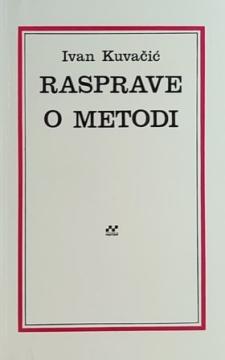
Rasprave o metodi
"Discourses on Method" is a collection of essays and discussions by the prominent Croatian sociologist Ivan Kuvačić (1924–2005), written during his many years of work at the Department of Sociology at the Faculty of Philosophy in Zagreb.
1,071 The book deals with key methodological problems of social sciences in the context of contemporary highly developed capitalist society (late 1970s and 1980s). Kuvačić critically analyzes the contradictions and tendencies of approaches to social reality: positivist empiricism vs. critical theory, quantitative vs. qualitative methods, objectivity vs. researcher engagement, reductionism vs. dialectics. He particularly focuses on the limitations of the positivist model (taken from the natural sciences) in the study of social phenomena – he believes that social sciences cannot be "pure" sciences because they are permeated with values, ideology and historical context.
The author advocates a critical, dialectical approach inspired by the Marxist tradition (Frankfurt School, Habermas, but also his own synthesis), where the method is not a technical tool, but a way of understanding social integrity, contradictions and possibilities of emancipation. He discusses the role of sociologists in society: should they be neutral observers or engaged critics who expose the mechanisms of domination and alienation.
"The discussions collected in this book were created during many years of work at the Department of Sociology of the Faculty of Philosophy in Zagreb as part of the teaching of epistemology. When I say that they primarily consider problems of approach, this means that I was most interested in those ideas that illuminate a field of research from a certain angle and thus serve as a guide. This also indicates that these are not abstract constructions, but ideas that are firmly connected to contemporary events. Their purpose is to encourage and assist comprehensively designed research into social phenomena. However, the field of research techniques and procedures is not explored. Except for two discussions in which the relationship between qualitative and quantitative approaches is analyzed."
One copy is available