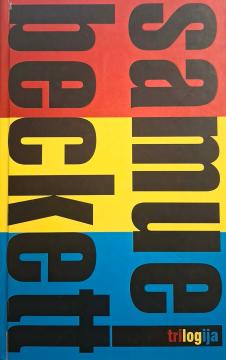
Triologija: Molloy, Malone umire, Neimenjivi

Triologija: Molloy, Malone umire, Neimenjivi

Samuel Beckett

He has marked the contemporary era like few others, and his heroes or "heroes" with their emotional and moral dilemmas, weighed down by existential anxiety and news of cataclysms and possible apocalypses, are closer to us than ever.

Beckett's trilogy consists of three novels: Molloy (1951), Malone Dies (1951), and The Unnameable (1953). These are key works of 20th-century modernist and existentialist literature, in which Beckett gradually dismantles classical plot, character identity, and narrative structure itself.

  1. Molloy

The novel is divided into two parts.

The first part is narrated by Molloy, a vagrant trying to find his mother. His journey is chaotic, full of repetitions, digressions, and memory lapses. He physically deteriorates, moving with increasing difficulty (first walking, then cycling, finally crawling), and the narration becomes increasingly unreliable. The second part follows Moran, a detective who is assigned to find Molloy. As the plot progresses, Moran becomes more and more like Molloy – physically and mentally deteriorating, his world falling apart, and the line between pursuer and pursued becomes blurred.

  1. Malone Dies

The main character, Malone, lies motionless in a room, waiting to die. He passes the time by telling stories and making lists of his remaining belongings. He tries to create characters (e.g. Sapo/Macmann), but his narration constantly gets out of hand. The line between Malone and his characters becomes blurred. The novel gradually disintegrates into fragmentary thoughts and interruptions, until an abrupt and incomplete ending.

  1. The Unnameable

The most radical part of the trilogy. There is no classic plot. A voice without a body, without an identity and without a clear position in space speaks in a long, almost uninterrupted monologue. The narrator questions his own existence, doubts all the identities attributed to him (Molloy, Malone, etc.) and tries to reach silence – but cannot stop talking. He ends with the famous line: “I must go on. I cannot go on. I will go on.”

Original title
Molloy, Malone dies, The unnamable
Translation
Gordana V. Popović
Editor
Krunoslav Jajetić
Graphics design
Kruno Jajetić
Dimensions
24 x 16 cm
Pages
390
Publisher
Šareni dućan, Koprivnica, 2014.
 
Latin alphabet. Hardcover.
Language: Croatian.

One copy is available

Condition:Used, excellent condition
 

Are you interested in another book? You can search the offer using our search engine or browse books by category.

You may also be interested in these titles

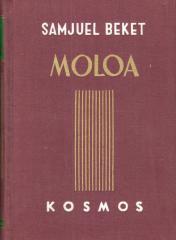
Moloa

Moloa

Samuel Beckett

The novel Molloy (1951) is the first part of Beckett's famous trilogy, along with Malone Dies and The Nameless. It is structured in two parts, each told from the perspective of a different narrator: first Molloy, then Jacques Moran.

Kosmos, 1959.
Serbian. Latin alphabet. Hardcover.
8.46
Razbojnici / Spletka i ljubav

Razbojnici / Spletka i ljubav

Friedrich Schiller

Two brothers, torn apart by the machinations of a younger, corrupt and deceitful creature, is a theme that is already familiar in the foundations of many literary works.

Svjetlost, 1966.
Croatian. Latin alphabet. Hardcover.
2.24
Dvori od oraha

Dvori od oraha

Miljenko Jergović

"The Walnut Courts" (2003) is one of Miljenko Jergović's most famous and moving novels. This novel remains one of the most important literary testimonies about the 20th century in the Balkans and the cost of forgetting.

Dani, 2005.
Croatian. Latin alphabet. Paperback.
12.38
Treće lice jednine

Treće lice jednine

Nedžad Maksumić

The third person singular is a very complicated and somewhat tricky stylistic device because all the characters in the novel are actually the author himself, and none of them are.

Buybook, 2018.
Croatian. Latin alphabet. Paperback.
10.98
Jemeljan Pugačov : historijski roman

Jemeljan Pugačov : historijski roman

Vjačeslav Šiškov
Nakladni zavod Hrvatske, 1948.
Croatian. Latin alphabet. Hardcover.
The book consists of two volumes
4.993.49
Frida Kalo i boje života

Frida Kalo i boje života

Karolin Bernard

The story of this exceptionally talented woman with a rebellious spirit and unconventional style, Frida Kahlo, and the colors of life is a statement of love for life, art, freedom, and the courage to conquer it anew every day.

Laguna, 2021.
Serbian. Latin alphabet. Paperback.
10.32