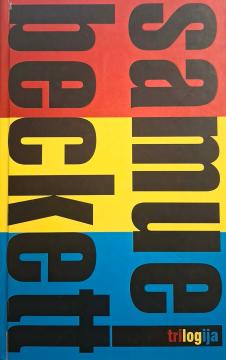
Triologija: Molloy, Malone umire, Neimenjivi

Triologija: Molloy, Malone umire, Neimenjivi

Samuel Beckett

He has marked the contemporary era like few others, and his heroes or "heroes" with their emotional and moral dilemmas, weighed down by existential anxiety and news of cataclysms and possible apocalypses, are closer to us than ever.

Beckett's trilogy consists of three novels: Molloy (1951), Malone Dies (1951), and The Unnameable (1953). These are key works of 20th-century modernist and existentialist literature, in which Beckett gradually dismantles classical plot, character identity, and narrative structure itself.

  1. Molloy

The novel is divided into two parts.

The first part is narrated by Molloy, a vagrant trying to find his mother. His journey is chaotic, full of repetitions, digressions, and memory lapses. He physically deteriorates, moving with increasing difficulty (first walking, then cycling, finally crawling), and the narration becomes increasingly unreliable. The second part follows Moran, a detective who is assigned to find Molloy. As the plot progresses, Moran becomes more and more like Molloy – physically and mentally deteriorating, his world falling apart, and the line between pursuer and pursued becomes blurred.

  1. Malone Dies

The main character, Malone, lies motionless in a room, waiting to die. He passes the time by telling stories and making lists of his remaining belongings. He tries to create characters (e.g. Sapo/Macmann), but his narration constantly gets out of hand. The line between Malone and his characters becomes blurred. The novel gradually disintegrates into fragmentary thoughts and interruptions, until an abrupt and incomplete ending.

  1. The Unnameable

The most radical part of the trilogy. There is no classic plot. A voice without a body, without an identity and without a clear position in space speaks in a long, almost uninterrupted monologue. The narrator questions his own existence, doubts all the identities attributed to him (Molloy, Malone, etc.) and tries to reach silence – but cannot stop talking. He ends with the famous line: “I must go on. I cannot go on. I will go on.”

Titel des Originals
Molloy, Malone dies, The unnamable
Übersetzung
Gordana V. Popović
Editor
Krunoslav Jajetić
Titelseite
Kruno Jajetić
Maße
24 x 16 cm
Seitenzahl
390
Verlag
Šareni dućan, Koprivnica, 2014.
 
Latein Schrift. Hardcover.
Sprache: Kroatisch.

Angeboten wird ein Exemplar

Zustand:Gebraucht, in ausgezeichnetem Zustand
Zum Warenkorb hinzugefügt!
 

Interessieren Sie sich für ein anderes Buch? Sie können das Angebot über unsere Suchmaschine suchen und finden oder Bücher nach Kategorien durchsuchen.

Diese Titel könnten Sie auch interessieren

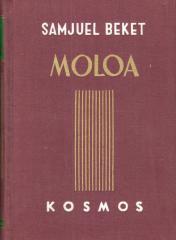
Moloa

Moloa

Samuel Beckett

The novel Molloy (1951) is the first part of Beckett's famous trilogy, along with Malone Dies and The Nameless. It is structured in two parts, each told from the perspective of a different narrator: first Molloy, then Jacques Moran.

Kosmos, 1959.
Serbisch. Latein Schrift. Hardcover.
8,46
Aurorin poticaj

Aurorin poticaj

Erich Hackl

The work is based on a true event that occurred in Spain in 1933: Aurora Rodriguez killed her daughter Hildegart, a famous fighter for women's emancipation and a cult figure on the political scene of the time.

Mladost, 1990.
Kroatisch. Latein Schrift. Fester Einband mit Schutzumschlag.
4,96 - 4,98
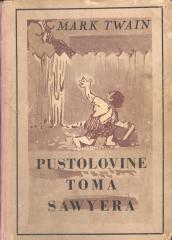
Pustolovine Toma Sawyera

Pustolovine Toma Sawyera

Mark Twain

The Adventures of Tom Sawyer is the first truly realistic children's novel, not only in American but also in world children's literature. Twain's most famous work and a favorite children's book in which the writer described his boyhood experiences.

Nakladni zavod Hrvatske, 1947.
Kroatisch. Latein Schrift. Hardcover.
16,32
Knjižarevo obećanje: Cliff Janeway istražuje

Knjižarevo obećanje: Cliff Janeway istražuje

John Dunning

The Bookseller's Promise is the third book in the Cliff Janeway series by the award-winning John Dunning, an unusually talented and unique American writer.

Algoritam, 2006.
Kroatisch. Latein Schrift. Taschenbuch.
4,50 - 4,68
V.

V.

Thomas Pynchon

The novel represents a journey into an alternative world – a world that we all belong to from time to time, but of which we would not want to be a part, a world of paranoia and alienation that we are not entirely sure is just an alternative or the bare tr

Čarobna knjiga, 2010.
Serbisch. Latein Schrift. Taschenbuch.
21,9819,78
Jedna Svanova ljubav

Jedna Svanova ljubav

Marcel Proust
Rad, 1984.
Serbisch. Latein Schrift. Taschenbuch.
2,98