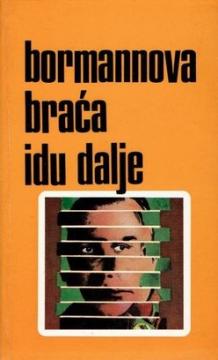
Bormannova braća idu dalje

Bormannova braća idu dalje

William Stevenson

The book reveals the secret network through which Martin Bormann, Hitler's treasurer, ensured the survival of Nazi power and capital after the fall of the Third Reich.

The Bormann Brothers Go On is an investigative story about the hidden continuation of the Nazi project after 1945. William Stevenson, a journalist and author known for his documentary approaches to real events, develops the thesis that Martin Bormann, a key figure in Hitler's inner circle and the financial manager of the Third Reich, prepared a large escape network during the war, known as the "Bormann Organization" or "Bormann Brotherhood".

According to the author, through a complex network of companies, banks and contacts around the world, Bormann ensured the escape of numerous high-ranking Nazis to South America, where they created new economic and political power under the auspices of industrial conglomerates. Stevenson argues that Nazi capital and connections continued to operate outside of Germany and influenced post-war geopolitics, the Cold War and international business circles.

The book combines elements of investigative journalism, historical reconstruction and spy fiction, often on the border between documented facts and controversial theories. Stevenson tries to show that Nazism did not end with the war, but transformed into a covert network of power operating behind the scenes of global politics and economics.

Original title
The Bormann Brotherhood
Translation
Vlasta Švarcmajer
Editor
Milan Osmak
Dimensions
20 x 12 cm
Pages
199
Publisher
NIŠRO "Vjesnik", Zagreb, 1977.
 
Latin alphabet. Hardcover.
Language: Croatian.

One copy is available

Condition:Used, excellent condition
 

Are you interested in another book? You can search the offer using our search engine or browse books by category.

You may also be interested in these titles

Snažan eho brionski: Odjeci Brionskog plenuma u Bosni i Hercegovini 1966. godine

Snažan eho brionski: Odjeci Brionskog plenuma u Bosni i Hercegovini 1966. godine

Amir Duranović

Amir Duranović's book reconstructs in detail the dramatic year 1966 and the Fourth (Brion) Session of the Central Committee of the Communist Party of Yugoslavia (July 1–2, 1966), at which Aleksandar Ranković, the long-time head of the UDB and vice preside

Udruženje za modernu historiju (UMHIS), 2017.
Croatian. Latin alphabet. Paperback.
9.54
Nacionalni testament kralja Aleksandra I

Nacionalni testament kralja Aleksandra I

Branislav M. Stepanović

The author presents the political and ideological legacy of King Aleksandar I Karađorđević the Unifier. The book, published immediately after the king's death, is an attempt to preserve and transmit his political ideals to future generations.

Jugoslovenska biblioteka "Bratstvo", 1936.
Serbian. Cyrillic alphabet. Hardcover.
28.36
O boljševizmu (1920-1921) - zabranjeni Masarik

O boljševizmu (1920-1921) - zabranjeni Masarik

Tomáš G. Masaryk

In this edition, translated by dr. Aleksandar Ilić, there are texts of the first Czechoslovak president in which he timely criticizes Marx, Engels and Lenin, and actually goes on to criticize imperialism in general.

Zavod za udžbenike i nastavna sredstva, 2014.
Serbian. Cyrillic alphabet. Paperback.
9.76
Pucanj u Kennedyja: Životna priča i dramatična smrt voljenog predsjednika

Pucanj u Kennedyja: Životna priča i dramatična smrt voljenog predsjednika

Bill O'reilly, Martin Dugard

In the middle of a campaign visit to Dallas in 1963, President J.F. Kennedy was assassinated. This is his life story, about his political career, about his dramatic death and the events surrounding it. The assassination shook America, changed its history

Profil Knjiga, 2013.
Croatian. Latin alphabet. Paperback.
13.46
Turska noć

Turska noć

Philippe Videlier

The crime against the Armenians is only coming to light today. After almost a century, the tragedy of a nation, the indifference of the Constantinople authorities, the media cover-up and the turning of the international community's head are unfolding befo

Durieux, 2010.
Croatian. Latin alphabet. Hardcover with dust jacket.
11.428.57
Radni logor Valpovo 1945.-1946.: dokumenti

Radni logor Valpovo 1945.-1946.: dokumenti

Vladimir Geiger

The Valpovo labor camp (1945–1946) was the largest camp for Volksdeutschers in Croatia after World War II. About 4,000 Germans and Austrians were interned; at least 1,074 died, mostly from hunger, disease, and exhausting labor.

Njemačka zajednica podunavskih Švaba u Hrvatskoj, 1999.
Croatian. Latin alphabet. Hardcover.
27.34