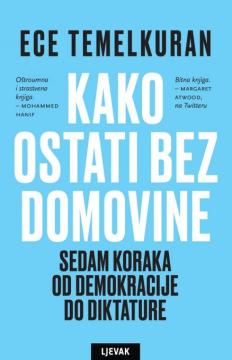
Kako ostati bez domovine: Sedam koraka od demokracije do diktature

Kako ostati bez domovine: Sedam koraka od demokracije do diktature

Ece Temelkuran

In her book, Ece Temelkuran analyzes how societies are gradually sliding into authoritarianism. Through personal experiences and global examples, she reveals patterns of loss of freedom, compassion, and truth in the modern world.

How to Lose a Homeland: Seven Steps from Democracy to Dictatorship is the work of Turkish journalist and writer Ece Temelkuran, who, based on personal experiences and political analysis, describes how democracies around the world are slowly, almost imperceptibly, turning into authoritarian regimes. After having to leave Turkey for writing critically about the government, the author uses her example as a warning – what happened in her country can happen anywhere.

The book is structured in seven steps that lead to the loss of democracy: from the manipulation of public discourse and fake news, through the demonization of “others”, to the complete control of institutions and the breakdown of trust among citizens. Temelkuran compares the processes in Turkey with those in Hungary, the United States, Poland and other countries, emphasizing the universality of political mechanisms that encourage populism and hatred.

The author combines a personal story with an analysis of social trends, writing passionately but lucidly about the erosion of truth and empathy. Despite its pessimistic insights, the book is also an appeal for renewed solidarity, dialogue, and the courage to speak out against injustice.

How to Be Left Without a Homeland is a powerful, engaging work that exposes contemporary threats to democracy and calls on the reader not to be a passive witness to their spread.

Original title
How to Lose a Country: The 7 Steps from Democracy to Dictatorship
Translation
Ivica Buljan
Editor
Nada Brnardić
Dimensions
23 x 15 cm
Pages
195
Publisher
Naklada Ljevak, Zagreb, 2019.
 
Latin alphabet. Paperback.
Language: Croatian.

One copy is available

Condition:Unused
 

Are you interested in another book? You can search the offer using our search engine or browse books by category.

You may also be interested in these titles

Doživljaji i putovanja do slobode

Doživljaji i putovanja do slobode

Vladimir Novak

The autobiographical work of Croatian communist activist Vladimir Novak, a survivor of the Ustasha camps, follows his memories of resistance to fascism during World War II.

August Cesarec, 1979.
Croatian. Latin alphabet. Hardcover with dust jacket.
8.266.20
Put u Jajce

Put u Jajce

Edvard Kocbek

In Put u Jajce, Edvard Kocbek provides personal and political testimony about key moments in Yugoslav history. The book is based on Kocbek's memories from the Second World War, especially the trip to Jajce in 1943.

Znanje, 1978.
Croatian. Latin alphabet. Hardcover with dust jacket.
8.385.87
Pregled ratne veštine

Pregled ratne veštine

Baron de Jomini

The Outline of the Art of War, a work by Baron Antoine-Henri Jomini from 1838, is a classic military treatise that systematizes the principles of warfare, focusing on strategy, grand tactics, and military policy.

Vojnoizdavački zavod "Vojno delo", 1952.
Serbian. Cyrillic alphabet. Hardcover.
18.56
Kritika srpskog uma

Kritika srpskog uma

Novica Milić

The book's starting point is that the Serbs were not only caught up in the Enlightenment later than its European foray in the 18th century, but they resisted it even when it caught up with them. In the Balkans, history followed different paths, had differ

Most art Jugoslavija, 2023.
Serbian. Cyrillic alphabet. Paperback.
9.98
Živojin Pavlović: Između dogme i kritike

Živojin Pavlović: Između dogme i kritike

Slobodan Gavrilović

In terms of the number and content of facts, systematics, and method of interpretation, Gavrilović's work surpasses ordinary historiographical reading and stands side by side with the best literary creations about the events of one time and their actors.

Grafocard, 2001.
Serbian. Cyrillic alphabet. Paperback.
9.58
Marija Terezija

Marija Terezija

Karl Tschuppik

A biography of the Habsburg Empress Maria Theresa, one of the most influential rulers of the 18th century. Tschuppik, an Austrian historian and journalist, provides a vivid portrait of her life and reign, combining historical facts with a narrative style.

Binoza, 1936.
Croatian. Latin alphabet. Hardcover.
8.32