Kako ostati bez domovine: Sedam koraka od demokracije do diktature

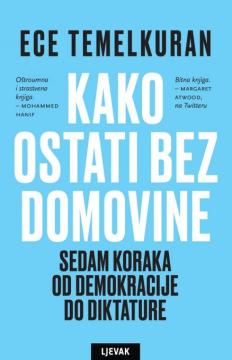
Kako ostati bez domovine: Sedam koraka od demokracije do diktature

Ece Temelkuran

In her book, Ece Temelkuran analyzes how societies are gradually sliding into authoritarianism. Through personal experiences and global examples, she reveals patterns of loss of freedom, compassion, and truth in the modern world.

How to Lose a Homeland: Seven Steps from Democracy to Dictatorship is the work of Turkish journalist and writer Ece Temelkuran, who, based on personal experiences and political analysis, describes how democracies around the world are slowly, almost imperceptibly, turning into authoritarian regimes. After having to leave Turkey for writing critically about the government, the author uses her example as a warning – what happened in her country can happen anywhere.

The book is structured in seven steps that lead to the loss of democracy: from the manipulation of public discourse and fake news, through the demonization of “others”, to the complete control of institutions and the breakdown of trust among citizens. Temelkuran compares the processes in Turkey with those in Hungary, the United States, Poland and other countries, emphasizing the universality of political mechanisms that encourage populism and hatred.

The author combines a personal story with an analysis of social trends, writing passionately but lucidly about the erosion of truth and empathy. Despite its pessimistic insights, the book is also an appeal for renewed solidarity, dialogue, and the courage to speak out against injustice.

How to Be Left Without a Homeland is a powerful, engaging work that exposes contemporary threats to democracy and calls on the reader not to be a passive witness to their spread.

Original title
How to Lose a Country: The 7 Steps from Democracy to Dictatorship
Translation
Ivica Buljan
Editor
Nada Brnardić
Dimensions
23 x 15 cm
Pages
195
Publisher
Naklada Ljevak, Zagreb, 2019.
 
Latin alphabet. Paperback.
Language: Croatian.

One copy is available

Condition:Unused
 

Are you interested in another book? You can search the offer using our search engine or browse books by category.

You may also be interested in these titles

S političarima u četiri oka

S političarima u četiri oka

Branko Tuđen

The author, journalist and editor, follows the events of the second half of the 1980s, the breakup of Yugoslavia and the fight for Croatian independence in his diary entries.

Naklada Ljevak, 2007.
Croatian. Latin alphabet. Paperback.
8.50
Zašto je ubijen Ivo Pukanić?

Zašto je ubijen Ivo Pukanić?

Berislav Jelinić

The best-selling Croatian journalistic book of 2009. The author, long-time journalist and editor of Nacional Berislav Jelinić (who succeeded Pukanić as head of the weekly), wrote it just a year after the assassination on October 23, 2008 in Zagreb.

Sljedeći savjet, 2014.
Croatian. Latin alphabet. Paperback.
18.32 - 24.5619.65
Kriza i ekonomska politika

Kriza i ekonomska politika

Dubravko Radošević

The works of the best Croatian economists in the field of politics and economics of economic development in Croatia were presented.

Jesenski i Turk, 2010.
Croatian. Latin alphabet. Paperback.
9.907.92
Obama – Vanjskopolitička doktrina

Obama – Vanjskopolitička doktrina

Jeffrey Goldberg

The American president talks about his toughest decisions about America's role in the world.

Mate d.o.o, 2016.
Croatian. Latin alphabet. Paperback.
9.49
Protiv straha: članci, izjave i javni nastupi 1987.–1992.

Protiv straha: članci, izjave i javni nastupi 1987.–1992.

Ivo Banac

This collection brings together political texts, interviews, speeches and public appearances by Ivo Banac from the key period of the breakup of Yugoslavia and the rise of Croatian statehood.

Slon, 1992.
Croatian. Latin alphabet. Paperback.
6.32
Radovan Karadžić: Uzroci, postanak i uspon genocida u Bosni i Hercegovini

Radovan Karadžić: Uzroci, postanak i uspon genocida u Bosni i Hercegovini

Robert J. Donia

Robert J. Donia's book provides an analytical look at Karadzic's life and the political, ideological, and social processes that led to war crimes and genocide in the 1990s.

University press, 2016.
Croatian. Latin alphabet. Paperback.
32.56