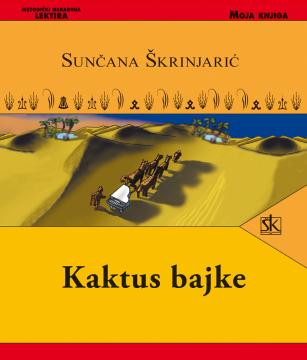
Kaktus bajke

Kaktus bajke

Sunčana Škrinjarić

A collection of eight modern fairy tales in which fantasy and reality intertwine through stories about friendship, loneliness, and acceptance of diversity. In the new edition, the book was edited by Dubravka Zima and methodically edited by Kristina Kostad

Cactus Fairy Tales by Sunčana Škrinjarić is one of the most recognizable collections of Croatian children's literature of the 20th century. It was edited by literary theorist Dubravka Zima and methodically edited by Kristina Kostadinovska, making the edition both literary and educationally valuable. The collection contains eight stories that combine fantastic and real elements, set in the world of everyday life — the forest, the city, or children's dreams.

Škrinjarić, known for her poetic language and gentle humor, creates a series of characters in Cactus Fairy Tales that speak about the themes of friendship, love, loneliness, and acceptance of diversity. The main characters are unusual creatures and children – a lonely cactus, the sparrow Sivokap, Mrvica, Dandelion, and others – who discover great moral truths through their small adventures. The author moves away from the traditional structure of a fairy tale and creates a modern, emotionally subtle world in which the fantastic becomes a means of understanding reality.

Although there are no fairies, giants or dwarfs in the stories, the omnipotence of events and poetic symbolism are present. The collection invites young readers to recognize the magic of life in the world of nature and everyday things. With an edition that also includes expert commentary, methodological guidelines and illustrations by Simon Bogojević Narath, Cactus Fairy Tales remains a fundamental work of Croatian children's literature that transcends generational boundaries and combines the warmth of childhood with the wisdom of adults.

Editor
Dubravka Zima
Illustrations
Simon Bogojević Narath
Graphics design
Dubravka Rakoci
Dimensions
20.5 x 17.5 cm
Pages
222
Publisher
Školska knjiga, Zagreb, 2000.
 
Latin alphabet. Hardcover.
Language: Croatian.
ISBN
978-9-53060-151-2

One copy is available

Condition:Used, excellent condition
 

Are you interested in another book? You can search the offer using our search engine or browse books by category.

You may also be interested in these titles

Pisac i princeza

Pisac i princeza

Sunčana Škrinjarić

Intended for a more demanding teenage audience, the novel speaks inspiredly about her problems, but also about universal problems.

Dnevnik, 1983.
Croatian. Latin alphabet. Paperback.
4.98
Ulica predaka

Ulica predaka

Sunčana Škrinjarić

The novel tells the story of a boy named Viktor who, after moving, finds himself in a strange and mysterious street. The street is filled with old houses and unusual residents, and the most enigmatic is an old woman who reveals to him that the street hide

Mladost, 1980.
Croatian. Latin alphabet. Hardcover.
4.98
Suvišan u svemiru

Suvišan u svemiru

Milivoj Matošec

With this novel for children, Matošec has confirmed his penchant for creating a "hybrid", because apart from being primarily science fiction, the novel also belongs to the children's crime novel, adventure novel and romance genre. It is a reading for the

Školska knjiga, 1986.
Croatian. Latin alphabet. Paperback.
3.96
Bakonja fra Brne

Bakonja fra Brne

Simo Matavulj
Školska knjiga, 1985.
Croatian. Latin alphabet. Hardcover.
3.62
Jedna Swannova ljubav / Preobražaj / Čovjekova sudbina

Jedna Swannova ljubav / Preobražaj / Čovjekova sudbina

Marcel Proust, Franz Kafka, Mihail Šolohov

The selection of titles of selected high school reading offered in this way is threefold in its thematic focus, which is seen in Proust in the old world, in Sholokhov in the new life, and in Kafka in the unreliable sign of man.

Stvarnost, 1989.
Croatian. Latin alphabet. Paperback.
8.74
Mirisi, zlato i tamjan

Mirisi, zlato i tamjan

Slobodan Novak

A novel by Croatian writer Slobodan Novak, written in 1967 and published in 1968. It is one of the most highly regarded novels in Croatian literature in general. It is often cited as an example of existentialist literature. It is told through the monologu

Školska knjiga, 1980.
Croatian. Latin alphabet. Paperback.
2.42 - 2.56