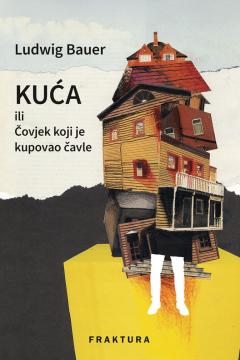
Kuća ili Čovjek koji je kupovao čavle

Kuća ili Čovjek koji je kupovao čavle

Ludwig Bauer

The House is a novel about the everyday life of a small man in late socialist Yugoslavia. Through the fate of Daniel Beker and his dreams of returning to his homeland, Bauer builds a warm, humorous and bitter fresco of a time.

Daniel Beker, an enigmatic man, accidentally becomes a teacher at the Yugoslav Supplementary School in London. Although his students adore him, he is not very good at the job, because he is expected to be loyal to the socialist system. He, naive, only wants to give his best to his students, not realizing what can happen. His wife is an ambitious and strong woman whose dream is to achieve a career in the banking world, while Daniel dreams of his own home, a house near Zagreb, and she supports him in his efforts to return to his homeland, so that she does not get in the way.

We recognize the heroes of The House as our parents, grandparents, everyday heroes through whom history is refracted. The construction of the house, very realistically described, with machinations and delays, with humorous elements, incompetent craftsmen and numerous brokers, can never be completed and succeeded, nor can the construction of a better society.

Ludwig Bauer in The House or The Man Who Bought Nails painted a fresco of the last decades of socialism. The novel is about two lovers who, driven by their obsessions – the house or the career – gradually drift apart. The House shows the reverse side of the socialist system that breaks down in the face of its own ambitions just as Daniel Beker did, but above all The House is a story about people – their kindness and naivety, their greed and treachery, about whether we can ever understand each other.

Editor
Seid Serdarević
Graphics design
Mislav Lešić
Dimensions
20.5 x 13.5 cm
Pages
272
Publisher
Fraktura, Zaprešić, 2024.
 
Latin alphabet. Hardcover with dust jacket.
Language: Croatian.

One copy is available

Condition:Unused
 

Are you interested in another book? You can search the offer using our search engine or browse books by category.

You may also be interested in these titles

Voetbal, engelen, oorlog

Voetbal, engelen, oorlog

Miljenko Jergović, Julijana Matanović, Goran Tribuson, Ludwig Bauer, Ratko Cvetnić, Zoran Ferić, ...
KLIN, 2013.
German. Latin alphabet. Paperback.
7.50
Zavičaj, zaborav

Zavičaj, zaborav

Ludwig Bauer

The fate of the Danubian Germans, the individual against the system, and the relationship between men and women in a time burdened by history - the great themes of Ludwig Bauer - deeply pervade the novel Homeland, Oblivion.

Fraktura, 2017.
Croatian. Latin alphabet. Paperback.
8.62
Ronilac bisera

Ronilac bisera

Bauer says that everyone is unique, and the world often fails to recognize quiet talents and sensitive individuals. True growth occurs when an individual accepts themselves and dares to dive into their own depths – where the “pearl” parts of their persona

Aura, 2000.
Croatian. Latin alphabet. Hardcover.
8.22
Quo Vadis?

Quo Vadis?

Henryk Sienkiewicz

The novel Quo Vadis is a historical saga set in Rome during the reign of Emperor Nero. Written with epochal breadth, the work explores the conflict between early Christianity and decadent Roman society, with a love story at its center.

Minerva, 1964.
Serbian. Latin alphabet. Hardcover.
2.98
Kraljevstvo na kraju puta

Kraljevstvo na kraju puta

Jan Guillou

The Kingdom at the End of the Road is the third book in the Knight Templar series by Jan Guillou. This book follows the fictional character Arno Magnusson who returns home to Sweden after 20 years as a Knight Templar.

Znanje, 2011.
Croatian. Latin alphabet. Paperback.
3.94
Ženski orkestar

Ženski orkestar

Fania Fenelon

Fanie Fénelon's novel The Women's Orchestra is a memoir that describes her experience of surviving in a women's orchestra at the Auschwitz-Birkenau concentration camp during World War II.

Globus, 1985.
Croatian. Latin alphabet. Hardcover with dust jacket.
8.74