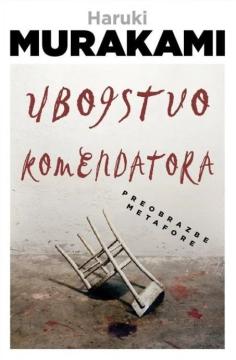
Ubojstvo komendatora 2: Preobrazbe metafore

Ubojstvo komendatora 2: Preobrazbe metafore

Haruki Murakami

The Tokyo painter is abandoned by his wife and the thirty-year-old portrait artist finds himself alone in the mountain house of the famous artist Tomohiko Amada. He discovers a strange painting in the attic and inadvertently sets in motion a circle of mysterious circumstances. To close it, he embarks on a journey that involves a mysterious bell, a dwarfish embodiment of an idea, an elegant businessman living at the other end of the valley, a thirteen-year-old girl who is too mature for her age, the Nazis and an assassination in Vienna during World War II, a pit in the woods behind the painter's house, and an underground inhabited by double metaphors. A sumptuous ode to love and loneliness, war and art, a tribute to The Great Gatsby, The Killing of the Commander is a brilliant figment of the imagination of one of today's greatest writers.

Original title
Killing commendatore, volume two
Translation
Vojo Šindolić
Editor
Milana Vuković Runjić
Graphics design
Boris Runjić
Dimensions
23.5 x 15.5 cm
Pages
357
Publisher
Vuković & Runjić, Zagreb, 2020.
 
Latin alphabet. Paperback.
Language: Croatian.

One copy is available

Condition:Used, excellent condition
 

Are you interested in another book? You can search the offer using our search engine or browse books by category.

You may also be interested in these titles

Začuđeni svatovi

Začuđeni svatovi

Eugen Kumičić

The novel "The Surprised Wedding Party" tells the story of the unrequited love of Antonio, a poor young man, for the beautiful daughter of a fisherman, Marija. Along with the aforementioned love story, another plot stands out, and that is the secret love

Školska knjiga, 1982.
Croatian. Latin alphabet. Paperback.
The book consists of two volumes
2.00 - 5.64
Usta puna zemlje

Usta puna zemlje

Branimir Šćepanović

The novel "Usta puna zemlje" (1970), the masterpiece of the Serbian writer Branimir Šćepanović, is a psychologically in-depth explorer of the limits of the human soul, solitude and existential freedom, reminiscent of Kafka and Camus.

BIGZ, 1987.
Serbian. Latin alphabet. Paperback.
3.98
Glad na ledini

Glad na ledini

Agustin Stipčević
Zora, 1968.
Croatian. Latin alphabet. Hardcover with dust jacket.
5.22
Rudnik čvaraka

Rudnik čvaraka

Tomislav Šovagović

The debut work of Croatian writer Tomislav Šovagović, awarded the Josip and Ivan Kozarac Award in 2012, is a dedication to Slavonia – the region of his childhood that the author, born in Dalmatia, observes with foreign but tender eyes.

Mozaik knjiga, 20112.
Croatian. Latin alphabet. Paperback.
11.56
Deobe 1-3

Deobe 1-3

Dobrica Ćosić

This work, awarded the NIN Prize for that year, is considered one of the most significant in Serbian literature after World War II.

Prosveta, 1961.
Serbian. Cyrillic alphabet. Hardcover with dust jacket.
The book consists of 3 volumes
11.42
Proces

Proces

Franz Kafka

Kafka wrote The Process between 1914 and 1915, published posthumously in 1925. The novel is unfinished but with an added final chapter by Max Brod. Edition with a foreword by B. Živojinović and an afterword by Walter Killi.

BIGZ, 1990.
Serbian. Latin alphabet. Paperback.
4.26