Nos
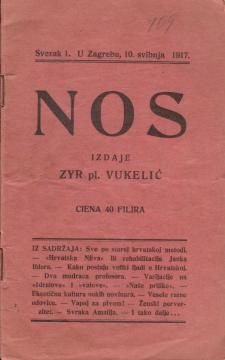
The satirical magazine Nos (vol. 1, May 10, 1917) by Zyra Vukelić pokes fun at everyday wartime life and domestic vanities: short, sharp sketches about politics, journalism, and "reputation," written in the midst of World War I.
Nos is a small, fast-paced and bitingly humorous newspaper published by Zyr pl. Vukelić on May 10, 1917, in the midst of World War I. The very first text, What has the war taught Croats?, sets the tone: it is not about grand military stories, but about our habits, fears and boasting under the warlike guise of the “common good”. Vukelić, a master of the short form, cuts short and legible — like a newspaper column that asks for no mercy.
The cover announced topics that still sound unpleasantly familiar today: “Everything according to the old Croatian method”, “How great people become great in Croatia”, “Two wise professors”, “Our circumstances”, “The exotic culture of some journalists”, “Merry war widows”, “Cry for beer!”, “Female perversion”, “Magpie Amalija”… These are mini-essays, vignettes and jokes in which the author calls out feigned seriousness, salon smarts and media posturing, and the war serves as a magnifier of all these weaknesses.
The style is brisk and polemical, with many aphorisms and short cuts; each section targets a habit or figure of power and ends with a clean, “on the nose” point. Although the context is 1917, the topics are universal: how “great people” are created, how the public is educated by headlines, how habit and interest override reason. At the same time, the newspaper is a document of the times: the language is alive, full of phrases and allusions of the time; Wartime scarcity peeks through in jokes (“Cry for beer!”), and the social costume reveals its seams.
Zyr pl. Vukelić is the pseudonym of Zvonimir Vukelić (1876–1943), a journalist, editor and satirist from Senj; in some sources he also appears as Zyr Xapula. He was the editor and founder of several newspapers (e.g. Hrvatska smotra), and under that name he published satirical booklets such as “Nos” (1917).
One copy is available