Nova sloboda: Poziv na oslobođenje plemenitih narodnih snaga
Rare book
Antique

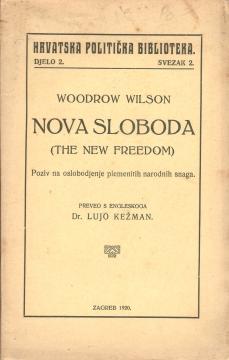
Nova sloboda: Poziv na oslobođenje plemenitih narodnih snaga

Woodrow Wilson

In The New Freedom, Wilson sets out his progressive program for the liberation of American society from monopoly, big capital, and corporate domination, and calls for the return of economic and political freedom to the common man.

The book represents Woodrow Wilson's political and economic program during his presidential campaign in 1912 and the foundation of his first administration. In it, Wilson sharply criticizes the dominance of large corporations, trusts, and monopolies, which, in his opinion, stifled the true economic freedom of the small entrepreneur, farmer, and ordinary citizen. He opposes the then prevailing belief that large monopolies are an inevitable product of a modern economy, arguing that they actually destroy competition, democracy, and individual initiative.

The main ideas of the book include:

  • liberation of the economy from monopoly power
  • reform of the banking system
  • strengthening of antitrust laws
  • democratization of politics and reduction of the influence of big capital on the state
  • return of freedom to the "little man" and release of his creative energies

Wilson's style is eloquent, idealistic, and moralistic - the book is not a dry economic treatise, but an inspiring call for the restoration of American democracy. In the Croatian context of 1920, immediately after World War I and the creation of the Kingdom of SHS, the translation had a special weight. Wilson was then extremely popular among the Croats and other South Slavic peoples because of his support for the principle of self-determination of peoples and his role in the Versailles Peace Conference.

The work is important because it represents a key document of American progressivism at the beginning of the 20th century and directly influenced Wilson's New Freedom policy, which opposed Theodore Roosevelt and his New Nationalism. Today it is considered a classic text of liberal and progressive thought.

Original title
The New Freedom
Translation
Lujo Kežman
Editor
Ivan Lorković
Dimensions
20.5 x 13 cm
Pages
160
Publisher
Hrvatska tiskara, Zagreb, 1920.
 
Latin alphabet. Paperback.
Language: Croatian.

One copy is available

Condition:Unused
 

Are you interested in another book? You can search the offer using our search engine or browse books by category.

You may also be interested in these titles

Ljubljana u borbi 1941–1945: Zbornik sećanja

Ljubljana u borbi 1941–1945: Zbornik sećanja

The collection brings together the memories of participants in the national liberation struggle in Ljubljana during World War II. The collection contains personal testimonies, which provide insight into the everyday life, struggle and sacrifices of the in

Vojnoizdavački zavod, 1978.
Serbian. Latin alphabet. Hardcover with dust jacket.
9.76
Vinodolski zakon 1288-1988: Faksimil/Diplomatičko izdanje/Kritički tekst/Tumačenje/Rječnik

Vinodolski zakon 1288-1988: Faksimil/Diplomatičko izdanje/Kritički tekst/Tumačenje/Rječnik

The collection published on the occasion of the 700th anniversary of the Vinodol Law is one of the most comprehensive editions of the key Croatian legal and cultural heritage. The collection contributes to an in-depth understanding of the Vinodol Law thro

Globus, 1988.
Croatian. Latin alphabet. Hardcover.
17.56
Hrvatska u arhivima izbjegličke vlade 1941-1943.: Izvještaji informatora o prilikama u Hrvatskoj

Hrvatska u arhivima izbjegličke vlade 1941-1943.: Izvještaji informatora o prilikama u Hrvatskoj

Ljubo Boban

Academician Ljubo Boban, in his work Croatia in the Archives of the Government in Exile 1941–1943, brings together a collection of diplomatic reports from various European and international representative offices of the Yugoslav government in exile during

Globus, 1985.
Croatian. Latin alphabet. Hardcover with dust jacket.
9.52
Izvještaj za školsku godinu 1946.-47. Prva gimnazija (muška) Osijek

Izvještaj za školsku godinu 1946.-47. Prva gimnazija (muška) Osijek

"Report for the school year 1946/47" of the First Boys' Gymnasium in Osijek is an annual school report from the first post-war period. It contains data on classes, students, teaching staff and the work of the school during the reconstruction period.

Glas Slavonije, 1947.
Croatian. Latin alphabet. Paperback.
13.24
Dan kada je nastala država Hrvatska 1991.

Dan kada je nastala država Hrvatska 1991.

Davorin Rudolf, Vladimir Šeks, Jasna Omejec

The collection brings together scholarly works on key political, legal, and diplomatic processes that led to the creation of the Croatian state in 1991, analyzing the decisions, actors, and international circumstances crucial to independence.

Hrvatska akademija znanosti i umjetnosti (HAZU), 2015.
Croatian. Latin alphabet. Paperback.
17.26
Historija porodice Alibegović: transformacija iz begovske zemljoposjedničke u modernu građansku porodicu

Historija porodice Alibegović: transformacija iz begovske zemljoposjedničke u modernu građansku porodicu

Husnija Kamberović

The book depicts the development of a Bosnian bey family that, throughout the 19th and 20th centuries, transformed from a landowning family into a modern bourgeois family, reflecting broader social changes in Bosnia and Herzegovina.

Udruženje za modernu historiju (UMHIS), 2021.
Croatian. Latin alphabet. Paperback.
18.52