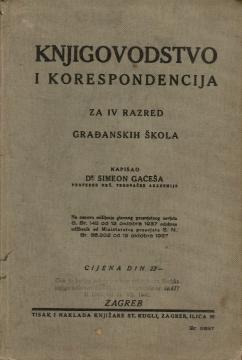
Knjigovodstvo i korespondencija: za IV razred građanskih škola zanatsko-industrijskog i poljoprivrednog pravca
The textbook "Bookkeeping and Correspondence" by Simeon Gaćeša for the 4th grade of civic schools (craft-industrial and agricultural majors) is a practical guide through the basics of bookkeeping and business correspondence.
Bookkeeping and Correspondence: for the 4th Grade of Civic Schools of the Craft-Industrial and Agricultural Direction is a school textbook published in 1937 by Simeon Gaćeša (1895–1978), a prominent Croatian economist, professor of accounting and later university lecturer.
The book is intended for students in the final, fourth grade of civic schools (then vocational extension schools) who were preparing for practical craft, industrial or agricultural jobs. At that time, civic schools were an important part of the vocational education system in the Kingdom of Yugoslavia, and bookkeeping and business correspondence were considered key skills for running small and medium-sized enterprises, crafts or agricultural farms.
Gaćeša, who had extensive practical and teaching experience (he taught at trade academies in Osijek, Zemun and Zagreb), wrote the textbook in a clear, concise and practical manner. The textbook was part of a wider series of Gaćeša's manuals for vocational schools (in the same year he also published Business Bookkeeping with Correspondence). It is written in simple language, with many examples, patterns and exercises, which was typical for school textbooks of that period.
The work reflects the economic reality of the Kingdom of Yugoslavia on the eve of World War II — an emphasis on practical skills for the development of small businesses and trades. Simeon Gaćeša later became a well-known author of numerous textbooks and professional works on bookkeeping, banking and business correspondence, and he taught at the Faculty of Economics in Zagreb.
Today, this book is a bibliographic rarity and an interesting source for the history of economic education, accounting practice and business culture in Croatia and Yugoslavia in the 1930s.
One copy is available
- Traces of patina