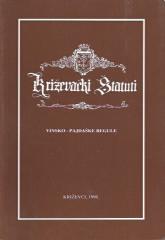
Statut grada Iloka iz godine 1525
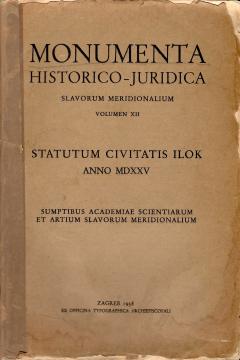
The Statute of the City of Ilok from 1525 provides a critical edition of the oldest preserved legal codex of Ilok, an important source for the study of city administration, law, and everyday life in late medieval Slavonia.
The Statute of the City of Ilok from 1525, edited by Rudolf Schmidt and published in 1938, is a scholarly edition of one of the most important legal and historical sources for the study of medieval Ilok. The work presents the text of the city statute drawn up in 1525, immediately before the Ottoman conquest of the city and the major political changes that affected the Croatian-Hungarian Kingdom after the Battle of Mohács in 1526.
The Statute of Ilok belongs to a group of medieval city legal codes that regulated the internal life, administration and legal relations within the city community. Its provisions cover issues of the city judiciary, the election and duties of city officials, trade, crafts, inheritance, property relations, criminal law and the maintenance of public order and security. The statute thus provides valuable insight into the organization of urban life in the far east of medieval Slavonia.
The document is particularly valuable because it testifies to the developed city autonomy of Ilok, which in the 15th and early 16th centuries was one of the most important economic and political centers between the Danube and the Sava. The provisions of the statute reveal the everyday problems of citizens, the way local government functioned, and the legal customs that shaped the life of the community immediately before the Ottoman invasion.
Rudolf Schmidt, a prominent historian and archivist, prepared the edition based on the original manuscript, equipping it with an introduction, expert comments, and notes that facilitate the understanding of the historical and legal context. The work is therefore simultaneously a valuable source for historians, legal historians, and researchers of urban development.
Today, the Statute of the City of Ilok from 1525 is considered one of the key sources for the study of the legal culture, social relations, and communal organization of medieval Slavonia on the eve of the Ottoman conquests, and an important monument of Croatian legal and cultural heritage.
One copy is available
- Beschädigter Rücken
- Beschädigte Abdeckungen