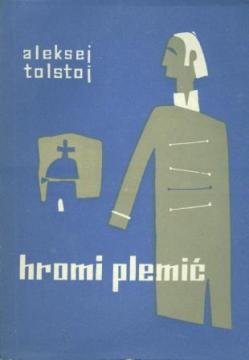
Hromi plemić

Hromi plemić

Aleksej K. Tolstoj

In the short story The Crippled Nobleman, the tragic fate of an unfortunate aristocrat becomes a parable about pride, pain, and transience. The author combines realism and romance into a deeply emotional story about human vulnerability and dignity.

The short story The Lame Nobleman by the Russian writer Alexei Konstantinovich Tolstoy (1817–1875) is a psychologically and morally layered work that explores human loneliness, sadness, and the need for love. Tolstoy, known for his historical novels, poetic ballads, and humorous stories, in this short story reaches a more intimate tone and shows compassion for a “little” man from the aristocratic class.

The main character, a nobleman who physically limps, is also marked by spiritual wounding. His lameness symbolizes not only a physical defect but also a sense of separation from the world, an inability to fit into a society that values ​​strength, youth, and external perfection. With an exceptional sense of psychological detail, Tolstoy depicts the inner life of a man struggling between pride and the need for closeness, between irony and sincere sadness.

The plot is simple, but charged with emotions: through everyday situations and encounters, the hero discovers how cruel social judgments are and how difficult it is to preserve dignity in a world that mocks weakness. Against the backdrop of a realistic picture of the Russian province, the author builds a universal message about human equality and compassion.

The style of the story is characterized by elegance, gentle humor and romantic empathy for the character. In The Lame Nobleman, Tolstoy combines a sentimental tone with moral reflection, showing that the true greatness of a person comes from his inner strength, and not from social position or physical perfection.

This work thus becomes a symbolic study of pride, pain and self-esteem, one of the most humane and emotionally moving prose works of Alexei K. Tolstoy.

Original title
Хромой барин
Translation
Dragutin Mičović
Editor
Gojko Janjušević
Graphics design
Jovan Lukić
Dimensions
17 x 11 cm
Pages
142
Publisher
Progres, Novi Sad, 1962.
 
Latin alphabet. Paperback.
Language: Serbian.

One copy is available

Condition:Used, excellent condition
 

Are you interested in another book? You can search the offer using our search engine or browse books by category.

You may also be interested in these titles

Knez Serebrjani

Knez Serebrjani

Aleksej N. Tolstoj
Matica hrvatska, 1961.
Croatian. Latin alphabet. Hardcover.
3.20 - 3.28
Članci (1942 - 1943)

Članci (1942 - 1943)

Aleksej N. Tolstoj
Nakladni zavod Hrvatske, 1945.
Croatian. Latin alphabet. Paperback.
2.65
Dvije priče: Priča o kmetu Simanu / Bife "Titanik"

Dvije priče: Priča o kmetu Simanu / Bife "Titanik"

Ivo Andrić
Školska knjiga, 1982.
Croatian. Latin alphabet. Paperback.
1.76 - 2.98
Krčma na plovnom putu

Krčma na plovnom putu

Mladen Markov

Mladen Markov (1934–2013), a Serbian prose writer from Vojvodina known for his themes from rural life in Bačka, war traumas, and post-war destinies, published the collection Krčma na plovnom putu as a selection of short stories.

BIGZ, 1980.
Serbian. Latin alphabet. Paperback.
1.99 - 3.28
Đurđevak

Đurđevak

Prežihov Voranc

One of the most touching stories about childhood in the poor peasant world of Prekomurje. Through autobiographical elements, Voranc depicts the world of a boy who faces fear and love, emphasizing poverty and family ties.

Svjetlost, 1989.
Croatian. Latin alphabet. Hardcover.
2.48 - 3.98
Sabrana djela A. P. Čehova #3: Drama u lovu i druge novele

Sabrana djela A. P. Čehova #3: Drama u lovu i druge novele

Anton Pavlovič Čehov

The third volume of Collected Works contains Chekhov's most extensive novella, "A Drama in Hunting," as well as a number of longer stories from the period 1885-1886. There are humoresques such as Silo in a Bag, Eh, That Audience, and A Lot of Paper, as we

Zora, 1959.
Croatian. Latin alphabet. Hardcover with dust jacket.
8.74