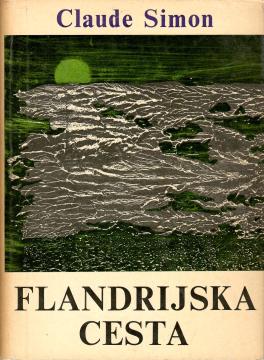
Flandrijska cesta
Rare book

Flandrijska cesta

Claude Simon

In Flanders Road, Claude Simon depicts the collapse of the French army in 1940 through the scattered memories of a soldier, exploring war, memory, and the fragility of human experience.

After the collapse of the French army in World War II, Georges tries to reconstruct the events that led to his captivity. As he remembers the chaotic retreat through Flanders, the death of officer de Reixach, the mysterious affair of his wife Corinne, and the possible betrayals that marked the fates of his comrades, the boundaries between past and present, reality and memory gradually blur. Instead of a linear war story, the reader is presented with a mosaic of fragments, scenes, and impressions that reflect the way the human mind remembers traumatic events.

In the novel The Flanders Road, one of the most important works of the French New Novel, Claude Simon creates an extremely demanding and hypnotic narrative in which time, perspective, and memory are as important as the events themselves. War is not depicted through heroism or grand historical gestures, but as an experience of chaos, meaninglessness, and the continuous disintegration of the world of known values.

With rich, rhythmic sentences and powerful visual images, Simon explores themes of death, love, inheritance, and the powerlessness of the individual in the face of the forces of history. The winner of the Nobel Prize for Literature, the author has created one of the key achievements of 20th-century European literature with this novel – a work that challenges, demands, and rewards the attentive reader.

Original title
La route des Flandres
Editor
Ivan Čaberica
Graphics design
Boris Dogan
Dimensions
20 x 14 cm
Pages
221
Publisher
Naprijed, Zagreb, 1963.
 
Latin alphabet. Hardcover with dust jacket.
Language: Croatian.

One copy is available

Condition:Unused
 

Are you interested in another book? You can search the offer using our search engine or browse books by category.

You may also be interested in these titles

Nada

Nada

Andre Malraux
Nolit, 1957.
Serbian. Latin alphabet. Paperback with dust jacket.
6.32
Zmija oko vrata I-II

Zmija oko vrata I-II

Lydia Scheuermann-Hodak

War-psychological prose set during the Homeland War (1991–1995), with a focus on Slavonia and partly on events in Bosnia. The work belongs to a cycle of prose about the war and women's experiences in it.

Grafika, 2004.
Croatian. Latin alphabet. Paperback.
The book consists of two volumes
9.76
Knights In White Armour: The New Art Of War And Peace

Knights In White Armour: The New Art Of War And Peace

Christopher Bellamy

The title of this text refers to the white armoured vehicles of UN forces around the world, and also to the UN's role as peacemakers, rescuers and guardians of law and order.

Pimlico, 1997.
English. Latin alphabet. Paperback.
4.01
Goli i mrtvi

Goli i mrtvi

Norman Mailer

Norman Mailer's novel The Naked and the Dead (1948) is a masterpiece of American literature about World War II. The plot follows a platoon of American soldiers on the fictional Pacific island of Anopopeia during their fight against the Japanese army.

Zora, 1964.
Croatian. Latin alphabet. Hardcover with dust jacket.
7.46
Istok i Zapad

Istok i Zapad

Gerald Green

In East and West (1986), Green weaves an epic tale of love and war, intertwining the lives of ordinary people with great historical events. The novel is a powerful fresco of war, but also of an indestructible spirit seeking light amidst darkness.

August Cesarec, 1990.
Croatian. Latin alphabet. Paperback.
The book consists of two volumes
7.42
Deobe

Deobe

Dobrica Ćosić

Deobe is a novel about the tragic division of Serbs into Chetniks and Partisans during World War II. Winner of the NIN Award, it is part of a wider epic trilogy, inspired by Ćosić's experiences and historical documents.

Prosveta, 1963.
Croatian. Latin alphabet. Hardcover with dust jacket.
13.74