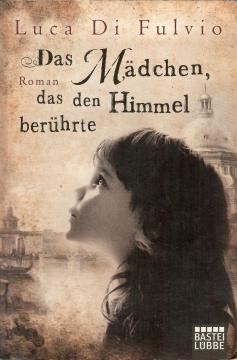
Das Mädchen, das den Himmel berührte

Das Mädchen, das den Himmel berührte

Luca Di Fulvio

In Renaissance Rome, a group of young thieves flee to Venice after a deadly confrontation with the Jew Simon. There, young Mercurio meets the Jewess Giuditta, and their love leads them through hatred and revenge.

The novel opens in historical Rome, at a time when hatred of Jews is growing among the impoverished masses. A group of teenagers, led by young Mercurio, who grew up on the streets and in a cave, survives by petty theft and fraud. One day, they rob a Jewish merchant named Simon Baruch, who brings in a year's income from his shop. The robbed Simon decides to take revenge; in the conflict, he kills a boy, but is himself seriously wounded and left speechless. Having abandoned his previous life, he sets off on an unstoppable pursuit of his attacker, leaving behind a trail of death and misfortune.

Stricken by loss, Mercurio and his group leave Rome and head for Venice, a city of hope and refuge, where they want to start a new life. At the same time, the Jewish woman Giuditta di Negroponte is traveling with her father Isaac. When their paths cross, Mercurio and Giuditta recognize each other as destined. But happiness is short-lived: circumstances separate them, the father opposes, and Simon's pursuit progresses inexorably.

Mercurio sets out in search of his lost love and will have to resist both family pride and religious fanaticism, while his former comrades turn into a threat. Over time, Mercurio matures from a street hustler into a freedom fighter, and Giuditta, without prospects, becomes an influential fashion designer. Through the labyrinth of Venetian streets and canals, between the splendor of St. Mark's and the misery of coastal taverns, Di Fulvio paints a Renaissance fresco about the power of love, hate, and redemption.

Original title
La ragazza che toccava il cielo
Translation
Katharina Schmidt, Barbara Neeb
Dimensions
18.5 x 12.5 cm
Pages
972
Publisher
Bastei Lübbe, Köln, 2013.
 
Latin alphabet. Paperback.
Language: German.

One copy is available

Condition:Used, excellent condition
 

Are you interested in another book? You can search the offer using our search engine or browse books by category.

You may also be interested in these titles

Tupa bol

Tupa bol

Milena Agus

Milena Agus is an award-winning Italian writer. Tupa bol is a novel that brought her international fame, and it was also made into a movie directed by Nicole Garcia and starring Marion Cotillard.

Profil Knjiga, 2019.
Croatian. Latin alphabet. Paperback.
5.42
Ravnodušni ljudi

Ravnodušni ljudi

Alberto Moravia

The novel follows the declining Roman bourgeois family of Ardengo over the course of several days: widow Mariagrazia, lover Leo, son Michele, and daughter Carla – all trapped in apathy, lies, sexual manipulation, and moral indifference.

Otokar Keršovani, 1966.
Croatian. Latin alphabet. Hardcover.
3.22
Meštar Don Gesualdo

Meštar Don Gesualdo

Giovanni Verga

The novel is an important representative of verismo, Italian realism, and depicts the lives of people from the south of Italy, especially the conflicts between the poor peasantry and the decaying aristocracy.

Matica hrvatska, 1947.
Croatian. Latin alphabet. Hardcover with dust jacket.
8.42
Priča o izgubljenoj djevojčici

Priča o izgubljenoj djevojčici

Elena Ferrante

The finale of a powerful saga about female friendship that became the literary hit of the decade. Ferrante's prose is sharp, intimate - like reading a diary of the soul. It reminds us that friendship is war and peace, and the lost girl within us - the key

Profil Knjiga, 2018.
Croatian. Latin alphabet. Paperback.
14.86
Hronika o siromašnim ljubavnicima

Hronika o siromašnim ljubavnicima

Vasco Pratolini

In Florence 1925–1926, in the poor Via del Corno, the residents live in love, poverty and fear. The arrival of fascism destroys the community: lovers fight, some die from violence, but popular solidarity survives.

Svjetlost, 1966.
Serbian. Latin alphabet. Paperback.
The book consists of two volumes
4.56
Čočara

Čočara

Alberto Moravia

Widow Cesira and her daughter Rosetta flee bombed Rome to their native Ciociaria, where they experience hunger, fear and misery. Liberation brings tragedy: Rosetta is raped by Moroccan soldiers, destroying their faith in God and people.

Otokar Keršovani, 1966.
Croatian. Latin alphabet. Hardcover.
3.96