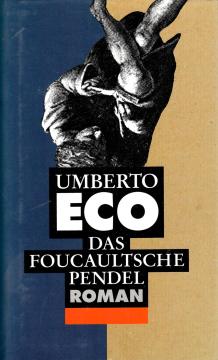
Das Foucaultsche Pendel
Three bored Milanese editors invent a gigantic conspiracy "Plan" linked to the Templars and occult societies. The game becomes a deadly reality.
Foucault's Pendulum (1988) is the second novel by Umberto Eco, a complex postmodern work that combines elements of historical novel, thriller, satirical comedy, and philosophical treatise. The title refers to Foucault's Pendulum in the Paris Musée des Arts et Métiers – a symbol of the Earth's rotation and, in the novel, the center of cosmic power according to a fictional conspiracy.
The plot follows three editors at the Milanese publishing house Garamond/Manutius: Jacopo Belbo, Diotallevi, and the narrator Casaubon. Surrounded by manuscripts by obscure authors obsessed with the occult (the so-called diabolici), they construct “The Plan” out of boredom and intellectual play – a gigantic meta-conspiracy that links the Knights Templar (after their abolition in 1307), the Rosicrucians, the Freemasons, the Cabala, Umbanda rituals, and other secret organizations into a single scheme for world domination based on telluric currents. Using the Abulafia computer, they randomly combine historical facts, legends, and pseudoscience into a coherent, but completely fictional, narrative.
What begins as an intellectual joke and parody of conspiracy obsession soon turns into a dangerous reality. People connected to the Plan disappear or are murdered, and real occultists and fanatics believe in their construction and try to make it happen. The novel explores the danger of semiotic “overinterpretation” of the world – the belief that behind every coincidence there is a hidden meaning. Eco masterfully shows how fiction can shape reality and how the desire for meaning can lead to paranoia, violence, and loss of identity.
The structure of the novel is complex: the story flows in multiple temporal layers, with rich flashbacks, quotes, and allusions to history, philosophy, semiotics, and literature. Eco plays with the reader – the book is simultaneously entertaining, tense, and deeply ironic. The satire is directed at conspiratorial thinking, pseudoscience, and intellectual snobbery, but also at the postmodern game of meanings itself.
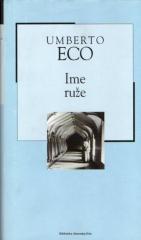
Foucault's Pendulum is considered one of Eco's most ambitious works – erudite, demanding and intellectually stimulating. Many compare it to The Name of the Rose, but here the emphasis is more on modernity, irony and criticism of a society obsessed with secrets. The novel warns: whoever searches too much for the hidden Plan in history risks creating it himself – with tragic consequences. A classic of contemporary world literature that rewards the patient reader with a wealth of ideas and narrative virtuosity.
One copy is available