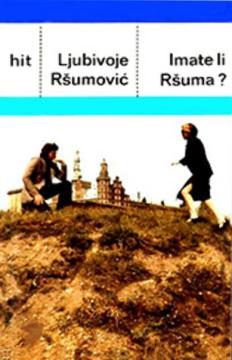
Imate li Ršuma?

Imate li Ršuma?

Ljubivoje Ršumović

Do You Have Ršum? is an autobiographical novel by Ljubivoje Ršumović about growing up, literary maturation, and dealing with one's own past. The work combines humor, poetry, irony, and a life confession.

Do You Have Ršum? is the first novel by Serbian writer Ljubivoj Ršumović, better known as a poet for children. Unlike his most famous children's books, this work is intended for adult readers and represents an unusual combination of autobiography, a coming-of-age novel, and a literary game. At the center of the story is the main character, who has many similarities with the author himself, and through a series of encounters, memories, and reflections tries to understand his own life and literary path.

The plot is not built as a classic linear story. Instead, it is composed of episodes that connect the past and the present. The hero returns to memories from childhood, youth, and his first literary attempts, meets people who have marked his life, and questions his own successes, misconceptions, and disappointments. A special place is occupied by events from his past that resurface and force him to confront himself.

One of the novel's greatest peculiarities is the constant mixing of reality and fiction. The work features real places, real people and elements of the author's biography, but Ršumović processes them through humor, irony and literary imagination, so the reader is never completely sure where reality ends and fiction begins. At the same time, the prose parts are often intertwined with verses, which gives the novel an original structure and additional emotional depth.

Through humorous situations, self-irony and comments on literary life, the author talks about maturation, human weaknesses, social relationships and the role of an artist in society. Do you have Ršum? is therefore not just a story about one man but also a novel about creating identity, the power of memory and the constant search for one's own place in the world.

Editor
Zlatko Crnčević
Graphics design
Alfred Pal
Dimensions
19.5 x 12 cm
Pages
139
Publisher
Znanje, Zagreb, 1983.
 
Latin alphabet. Hardcover with dust jacket.
Language: Croatian.

Two copies are available

Copy number 1

Condition:Used, excellent condition

Copy number 2

Condition:Used, excellent condition
Discounted price: 5.153.61
30% discount is valid until 6/9/26 11:59 pm
 

Are you interested in another book? You can search the offer using our search engine or browse books by category.

You may also be interested in these titles

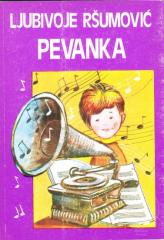
Pevanka

Pevanka

Ljubivoje Ršumović
Gradska narodna biblioteka "Žarko Zrenjanin", 1985.
Serbian. Latin alphabet. Paperback.
1.28
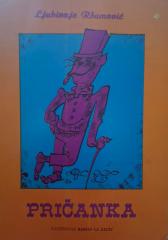
Pričanka

Pričanka

Ljubivoje Ršumović

Die Geschichte ist typisch für eine Sammlung von Ršumović, in der eine Kombination aus Humor und einfacher Ausdrucksweise bei Kindern die Liebe zur Poesie weckt.

Gradska biblioteka "Žarko Zrenjanin", 1982.
Serbian. Latin alphabet. Paperback.
6.00
Dok vrijeme prolazi

Dok vrijeme prolazi

Michael Walsch

Michael Walshs As Time Goes By setzt die Geschichte des Films Casablanca fort und erweitert sie. Er verfolgt das Schicksal von Rick, Ilsa und anderen Figuren während des Zweiten Weltkriegs, geprägt von Liebe, Krieg und gefährlichen Missionen.

Znanje, 1999.
Croatian. Latin alphabet. Paperback.
4.36
Kako to reći Liddy: jetka komedija

Kako to reći Liddy: jetka komedija

Anne Fine

Stellen Sie sich vier Schwestern vor, die alles miteinander teilen – von Shopping-Marathons und Familienessen bis hin zu den intimsten Geheimnissen. Heather, Bridie, Stella und Liddy Palmer – unzerbrechlich, treu, undurchdringlich. Zumindest denken sie da

Znanje, 1998.
Croatian. Latin alphabet. Paperback.
3.46
Druga generacija

Druga generacija

Howard Fast

Howard Fasts „Die zweite Generation“ ist ein Familienroman, der das Leben der Nachkommen einer erfolgreichen amerikanischen Familie schildert. Das Werk thematisiert Generationenkonflikte, Liebe, Ehrgeiz und sozialen Wandel.

Znanje, 1986.
Croatian. Latin alphabet. Hardcover with dust jacket.
The book consists of two volumes
8.34 - 8.36
Graditelj svratišta

Graditelj svratišta

Ivan Aralica

Der Wirtshausbauer ist ein realistischer historischer Roman in der Tradition von Andrić, jedoch mit Elementen der Fantasie, die Aralica mit dem mündlichen kroatischen Literaturwort, aber auch mit der fantastischen Literatur beispielsweise von Gabriel Garc

Znanje, 1987.
Croatian. Latin alphabet. Hardcover with dust jacket.
7.26