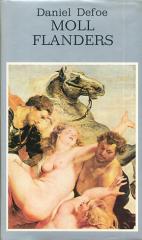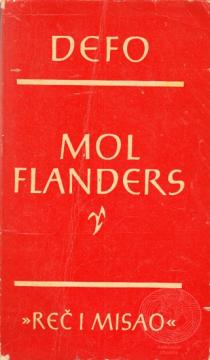
Mol Flanders
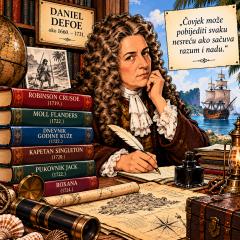
Daniel Defoe's *Moll Flanders* is a novel about a woman who struggles against poverty and social constraints in 17th-century England. Her life is marked by romantic liaisons, acts of deception, crimes, and a quest for security.
Moll Flanders (1722) is a novel by the English writer Daniel Defoe, one of the founders of the modern English novel. The work presents the life story of a woman who, faced with poverty and insecurity, strives to secure financial independence, social standing, and personal happiness.
The protagonist, Moll Flanders, was born in Newgate Prison; growing up without the protection of a family forced her to rely on her own resourcefulness from an early age. Throughout her turbulent life, she engages in numerous romantic relationships and marriages, experiences ups and downs, and gradually enters a world of fraud and theft. Her quest for security often confronts her with difficult moral choices.
The novel is structured as an autobiographical confession, lending the narrative immediacy and credibility. Through his heroine's fate, Defoe portrays 17th-century English society—particularly its attitudes toward women, the poor, and those lacking inheritance or social privilege.
Themes of money, marriage, social inequality, sin, guilt, and repentance play a significant role. Moll is not an idealized heroine; her actions are often contradictory, yet the reader gradually comes to understand the circumstances that shape her choices.
Defoe’s realistic style—rich in everyday details and psychologically convincing situations—creates a complex portrait of a woman attempting to survive in a world of limited opportunities. Moll Flanders is simultaneously an adventure, social, and moral novel, and its enduring value stems from its portrayal of human adaptability, the struggle for survival, and the possibility of personal redemption.
Two copies are available
Copy number 1
- Yellowed pages
Copy number 2
- Damaged covers
- Yellowed pages
- Library stamp