Slike iz svjetske književnosti III: Ruska književnost u osamnaestom stoljeću
Rare book
Antique

Slike iz svjetske književnosti III: Ruska književnost u osamnaestom stoljeću

Vatroslav Jagić

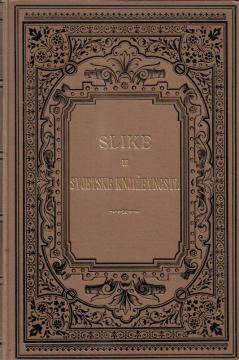
The book, in its original hardcover in Art Nouveau style and awarded by the Adolf Veber-Tkalčević Foundation for 1894, represents a pioneering work of Croatian literary theory and an introduction to a thorough study of the development of Russian literatur

Jagić, a prominent Slavist, structures the work in four parts, tracing the key phases of Russian literary and cultural development: the pre-Petrine period, the Petrovsky period, the period of Empress Catherine II, and the Karamzin period.

In the introduction, Jagić emphasizes the importance of the 18th century as the foundation for the later flowering of Russian literature in the 19th century. In the pre-Petrine part, he analyzes the struggle between old and new ideas, the beginnings of Russian theater, and the schism under Nikon, highlighting Avakum's autobiography as a key work. The Petrovsky period brings about the reforms of Peter the Great, with an emphasis on Theophan Prokopovich, Antioch Kantemir, Vasily Tredyakovskii, and Mikhail Lomonosov, who laid the foundations of modern Russian literature.

In the period of Empress Catherine II, Jagić explores her contribution, satirical newspapers, the works of Denis Fon-Vizin, Gavriil Derzhavin, and the influence of the encyclopedists, with Radishchev as a key figure. The Karamzin era brings a transition to Romanticism, with Nagyezhny as the father of the Russian novel and polemics between the Karamzinists and Shishkov's supporters.

Where is what?

I. From the pre-Petrine era (pp. 1-36); II. The Petrovsky era (pp. 37-97); III. The era of Empress Catherine (pp. 98-216); IV. The Karamzin era (pp. 217-258);

Bibliography of the subject pp. (259-281)

Dimensions
20.5 x 14 cm
Pages
284
Publisher
Matica hrvatska, Zagreb, 1895.
 
Latin alphabet. Hardcover.
Language: Croatian.

One copy is available

Condition:Used, excellent condition
 

Are you interested in another book? You can search the offer using our search engine or browse books by category.

You may also be interested in these titles

Sabrana djela A. P. Čehova #3: Drama u lovu i druge novele

Sabrana djela A. P. Čehova #3: Drama u lovu i druge novele

Anton Pavlovič Čehov

The third volume of Collected Works contains Chekhov's most extensive novella, "A Drama in Hunting," as well as a number of longer stories from the period 1885-1886. There are humoresques such as Silo in a Bag, Eh, That Audience, and A Lot of Paper, as we

Zora, 1959.
Croatian. Latin alphabet. Hardcover with dust jacket.
8.74
Asja

Asja

Ivan Sergejevič Turgenjev

The work is a typical example of Russian realism and deals with love, inner struggle, and missed opportunities.

Matica hrvatska, 1964.
Croatian. Latin alphabet. Hardcover with dust jacket.
7.725.79
Na modrom polju

Na modrom polju

Aleksej Remizov

The story of a girl named Olya Ilymeneva in a pre-revolutionary Russian village and province. Through a folkloric, ornamental style, Remizov describes her life, family, pilgrims, everyday life, and spiritual quest on the "blue field" of the Russian land.

Hrvatsko književno društvo Sv. Jeronima, 1928.
Croatian. Latin alphabet. Hardcover.
6.84
Dijalektika prijelaznog perioda

Dijalektika prijelaznog perioda

Viktor Pelevin

The book represents the author's anthology - the largest part is the novel Čisla (Čisla), followed by the short story Macedonian Criticism of French Thought and several short stories (Odin vog, Akiko, Fokus-grupa, Gost na prazniku bon).

Disput, 2006.
Croatian. Latin alphabet. Paperback.
9.68
Djetinjstvo

Djetinjstvo

Lav Nikolajevič Tolstoj

Childhood (1852) is the first book of an autobiographical trilogy (with Adolescence and Youth), where Tolstoy explores the world of childhood through the eyes of a ten-year-old boy, Nikolinka Irtenjev – innocence, joys, sorrows and first traumas.

Svjetlost, 1971.
Croatian. Latin alphabet. Hardcover.
6.54
Zlatno telešce

Zlatno telešce

Ilja Iljf, Evgenij Petrov

The Golden Calf (1931) follows the ingenious con artist Ostap Bender, who in Soviet Russia during the first five-year plan seeks a secret millionaire in order to get rich, encountering the absurdity of bureaucracy, the new Soviet man, and his own downfall

Naklada Binoza, 1934.
Croatian. Latin alphabet. Hardcover with dust jacket.
9.74