Povijest #2: Egipat i antička Grčka

Povijest #2: Egipat i antička Grčka

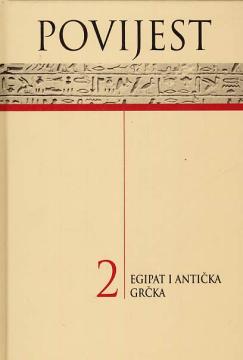
The second volume of the History of the World edition covers the entire history of Ancient Egypt and Ancient Greece, but also the history of the ancient peoples of India, classical Chinese culture, the civilizations of the ancient Far East, ancient Africa

The first part of the book is devoted to Egypt, from the emergence of civilization around 3000 BC to the Ptolemaic period. It describes the development of pharaonic rule, religion, art, and architecture, including the pyramids, temples, and hieroglyphic writing. Special emphasis is placed on social structure, science, and daily life along the Nile, as well as political changes, such as the reigns of Akhenaten and Cleopatra.

The second part focuses on ancient Greece, from the Mycenaean culture (1600–1100 BC) to the Hellenistic period. It covers the development of the polis (e.g. Athens, Sparta), Greek mythology, philosophy (Socrates, Plato, Aristotle), and art and literature (Homer, Sophocles). The book analyzes political conflicts, such as the Peloponnesian War, and the spread of Greek culture under Alexander the Great.

Lavishly illustrated, the book combines a chronological approach with thematic analysis, providing insight into the cultural heritage and influence of these civilizations on world history. The lack of recent archaeological discoveries has been criticized, but the work remains a valuable source for understanding the ancient world.

Original title
Storia del Mondo: Egitto e Grecia Antica
Translation
Ivana Bosanac, Marina Buza-Vidas, Katarina Perković i Nataša Vučić
Editor
Ivo Goldstein i Enrico Cravetto
Illustrations
Adom Macheroni
Dimensions
22 x 14 cm
Pages
623
Publisher
Europapress holding, Zagreb, 2007.
 
Latin alphabet. Hardcover.
Language: Croatian.
ISBN
978-9-53300-036-7

Two copies are available

Copy number 1

Condition:Unused

Copy number 2

Condition:Unused
 

Are you interested in another book? You can search the offer using our search engine or browse books by category.

You may also be interested in these titles

Najveće kulture svijeta 1: Egipat

Najveće kulture svijeta 1: Egipat

Ania Skliar

The Greatest Cultures of the World is a collection of eight books that talk about the world's great civilizations. The books were first published in Croatia in 2005 in Rijeka by the publisher Extrada d.o.o., but all eight books were also published specifi

Extrade, 2005.
Croatian. Latin alphabet. Hardcover.
6.32
Povijest #15: Kolonijalna carstva i imperijalizam (1871.-1914.)

Povijest #15: Kolonijalna carstva i imperijalizam (1871.-1914.)

The fifteenth volume of the World History series covers the period from 1871 to 1914, marked by the height of colonialism and imperialism. The book is richly illustrated, providing a comprehensive account of this period of global change and tension.

Europapress holding, 2008.
Croatian. Latin alphabet. Hardcover.
9.32 - 9.46
Povijest #5: Kasno Rimsko Carstvo i rani srednji vijek

Povijest #5: Kasno Rimsko Carstvo i rani srednji vijek

The fifth volume covers the final phase in the history of the Roman Empire, the rise of Byzantium and its adoption of the traditions of ancient Rome, as well as the history of Europe after the Great Migration of Peoples. The book ends with the expansion o

Europapress holding, 2007.
Croatian. Latin alphabet. Hardcover.
7.34 - 7.64
Ilustrirana povijest svijeta: Rani srednji vijek (907.-1154.)

Ilustrirana povijest svijeta: Rani srednji vijek (907.-1154.)

Karin Feuerstein-Praßer, Andrea Groß-Schulte, Marion Jung, Cornelia Lawrenz, Karin Prager, Otto S...

The fourth volume of Reader's Digest's "Illustrated History of the World" series, illustrated in color, intended for history buffs, provides an overview of key events and civilizational achievements around the world, in the period from 907 to 1154.

Mozaik knjiga, 2010.
Croatian. Latin alphabet. Hardcover.
11.56
Opuscula archaeologica IV: Zlatni nakit iz helenističko-ilirske nekropole u Budvi

Opuscula archaeologica IV: Zlatni nakit iz helenističko-ilirske nekropole u Budvi

Duje Rendić-Miočević

The article presents a classic analysis of archaeological findings from the Hellenistic period (3rd-2nd century BC) in the necropolis north of ancient Budva (today's Montenegro), discovered in the 1950s.

Filozofski fakultet Sveučilišta u Zagrebu, 1959.
Croatian. Latin alphabet. Paperback.
9.36
Povijest #13: Napoleon, restauracija i revolucionarna kretanja (1800.-1848.)

Povijest #13: Napoleon, restauracija i revolucionarna kretanja (1800.-1848.)

Europapress holding, 2008.
Croatian. Latin alphabet. Hardcover.
9.46