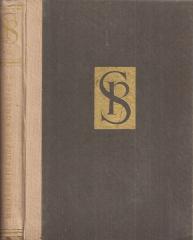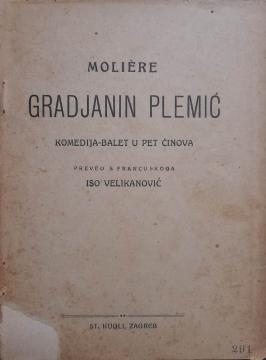
Gradjanin plemić: komedija-balet u pet činova
Rare book

Gradjanin plemić: komedija-balet u pet činova

Jean-Baptiste Poquelin Molière

The Citizen Nobleman (1670) is one of Molière's most famous and most performed comedies. It is a comedy-ballet in five acts, written for the court spectacle of Louis XIV, with music by Jean-Baptiste Lully.

The plot follows a wealthy but naive citizen Mr. Jourdain, who dreams of noble status. He hires teachers of dance, fencing, philosophy and music, spends huge amounts of money on luxury and allows himself to be deceived by nobles and charlatans. The funniest moment is when he is proclaimed a "mamamusi" - a fictional high nobleman - in a Turkish ceremony.

This edition was published by the reputable Zagreb publishing house St. Kugli. It was translated by Iso Velikanović, one of the most prolific and respected Croatian translators from French in the first half of the 20th century. The translation is classic, lively and humorous, and for a long time considered standard in the Croatian language.

The comedy is an eternal satire on vanity, social pretense and class ambitions. Molière asks with laughter: can someone buy noble status and culture with money? The answer is, of course, humorously devastating.

Original title
Le Bourgeois gentilhomme
Translation
Iso Velikanović
Dimensions
17 x 12.8 cm
Pages
128
Publisher
St. Kugli, Zagreb, 1922.
 
Latin alphabet. Paperback.
Language: Croatian.

One copy is available

Condition:Used, very good condition
Damages or inconvenience notice:
  • Damaged covers
 

Are you interested in another book? You can search the offer using our search engine or browse books by category.

You may also be interested in these titles

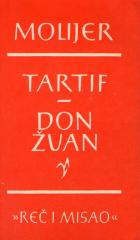
Tartif / Don Žuan

Tartif / Don Žuan

Jean-Baptiste Poquelin Molière
Rad, 1962.
Serbian. Latin alphabet. Paperback.
1.98 - 1.99
Izabrane komedije: Tartuffe / Mizantrop

Izabrane komedije: Tartuffe / Mizantrop

Jean-Baptiste Poquelin Molière
Matica hrvatska, 1942.
Croatian. Latin alphabet. Hardcover.
16.52
Kako što nastaje: novine, film, teatar

Kako što nastaje: novine, film, teatar

Karel Čapek

In a witty and instructive essay, Čapek describes how a newspaper, a film, and a theater play are created. Through humor and irony, he shows the complexity of the process – from idea to realization – and the different perspectives of the participants, dem

Znanje, 1985.
Croatian. Latin alphabet. Paperback.
4.76
Kazališne veze Osijeka i Pečuha / Eszék és Pécs színházi kapcsolata

Kazališne veze Osijeka i Pečuha / Eszék és Pécs színházi kapcsolata

Zvonimir Ivković

The book provides a thorough chronicle and analysis of centuries-old theatrical contacts between two cities – Osijek and Pécs – which historically shared the cultural space of the Pannonian Plain, especially during the period of the Habsburg Monarchy.

Matica hrvatska, 2012.
Croatian. Latin alphabet. Hardcover.
13.64
Hrvatska kazališna kritika

Hrvatska kazališna kritika

Šimun Jurišić

By deciding to select reviews exclusively from among those writers who have left this world a long or short time ago, the compiler avoided possible dissatisfaction among those who are still engaged in this work or have been engaged in it in the recent or

Logos, 2010.
Croatian. Latin alphabet. Paperback.
8.147.33
Stolice

Stolice

Eugene Ionesco

"Chairs" is a one-act play by Eugène Ionesco, one of the most significant representatives of the theater of the absurd, premiered in 1952. This edition was printed on the occasion of the play's premiere at the Zagreb Drama Theater in 1958.

Zagrebačko dramsko kazalište, 1959.
Croatian. Latin alphabet. Paperback.
7.26