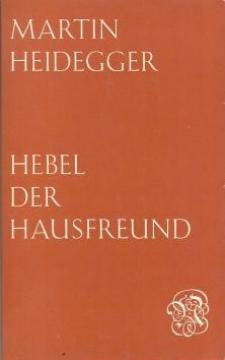
Hebel der Hausfreund
Rare book

Hebel der Hausfreund

Martin Heidegger

"Hebel – der Hausfreund" is based on a lecture given by Martin Heidegger in 1957, in which he reflects on the character and work of the German writer Johann Peter Hebel.

Heidegger does not approach Hebel as a literary critic, but rather observes him through a philosophical prism, emphasizing his relationship to Being, the world, and simple life.

Hebel is known for his collection of short stories and calendar stories that were addressed to the "little man" - miners, peasants, craftsmen. Heidegger sees in Hebel's stories a domestic way of thinking: a connection with nature, respect for everyday life, understanding life through small but important events.

For Heidegger, Hebel is not only a narrator, but also a guardian of Being - through simple stories he enables people to get closer to the deeper meaning of existence. Hebel's ability to see the extraordinary in ordinary things, to discover the miracle of life in everyday life, is a model of the way of thinking that Heidegger calls thoughtful.

"Hebel - a domestic friend" thus becomes Heidegger's appeal for the return of simplicity, gratitude, and modesty in a time of technological haste and alienation. Hebel teaches us how to live in the world, not just rule it.

The work reflects Heidegger's late philosophy, focused on silence, co-existence, and the discovery of Being through ordinary things.

Dimensions
20 x 13 cm
Pages
29
Publisher
Pfullingen Neske Verlag, Stuttgart, 1977.
 
Latin alphabet. Paperback.
Language: German.

One copy is available

Condition:Used, very good condition
Damages or inconvenience notice:
  • Signature of previous owner
 

Are you interested in another book? You can search the offer using our search engine or browse books by category.

You may also be interested in these titles

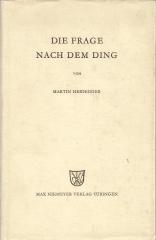
Die Frage nach dem Ding

Die Frage nach dem Ding

Martin Heidegger

The Question of Things, a collection of lectures given by Heidegger in 1935/36, deals with the fundamental philosophical question: What is a thing? His starting point is Kant's Critique of Pure Reason, but Heidegger goes further, wanting to clarify the ve

Max Niemeyer Verlag, 1975.
German. Latin alphabet. Hardcover with dust jacket.
24.99
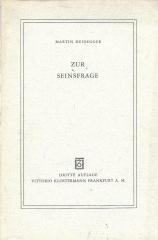
Zur Seinsfrage

Zur Seinsfrage

Martin Heidegger
Vitorio Klostermann, 1967.
German. Latin alphabet. Paperback.
14.99
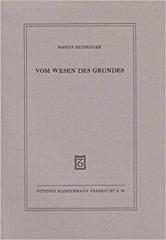
Vom Wesen des Grundes

Vom Wesen des Grundes

Martin Heidegger
Vitorio Klostermann, 1973.
German. Latin alphabet. Paperback.
14.99
Uvod u hermeneutiku

Uvod u hermeneutiku

Erwin Hufnagel
Hrvatska sveučilišna naklada, 1993.
Croatian. Latin alphabet. Paperback.
6.86
Lingvistika i poetika

Lingvistika i poetika

Roman Jakobson

In his lecture Linguistics and Poetics, Russian-American linguist Roman Jakobson (1896–1982) explores the relationship between language and literature, arguing that poetics is a subdivision of linguistics that deals with what makes a verbal message a work

Nolit, 1966.
Serbian. Latin alphabet. Paperback.
9.58
Kant

Kant

Alexandre Kojève

In his book Kant, the Russian-French philosopher Alexandre Kojève reinterprets Immanuel Kant as a key figure in the history of Western thought. According to Kojève, neo-Kantianism is a bourgeois intellectualism that despises action and participation in hi

Nolit, 1976.
Serbian. Latin alphabet. Paperback.
9.38