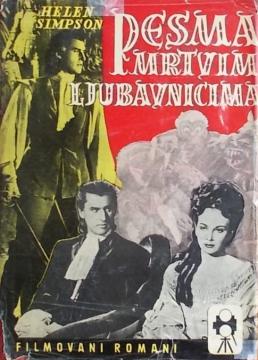
Pesma mrtvim ljubavnicima

Pesma mrtvim ljubavnicima

Helen Simpson

The story is known for its suggestive style, where tension builds gradually, more through atmosphere than through overt events. The ending remains partially open, which further enhances the sense of mystery and unease.

The plot follows a young married couple who move to an isolated house in the countryside. At first, everything seems peaceful and idyllic, but it is gradually revealed that the house hides a dark past connected to former lovers who ended up there tragically. As time passes, the relationship between the spouses becomes strained, and the line between reality and the supernatural becomes increasingly blurred.

Original title
Saraband for dead lovers
Translation
Anđelija Tokin
Editor
Jurij Gustinčić
Graphics design
Vladimir Gobunov
Dimensions
20 x 14 cm
Pages
263
Publisher
Kosmos, Beograd, 1956.
 
Latin alphabet. Hardcover.
Language: Croatian.

Two copies are available

Copy number 1

Condition:Used, very good condition
Damages or inconvenience notice:
  • Slight damage to the dust jacket

Copy number 2

Condition:Used, excellent condition
Damages or inconvenience notice:
  • The cover is missing
 

Are you interested in another book? You can search the offer using our search engine or browse books by category.

You may also be interested in these titles

Nedjeljni zapisi 1944-1994.

Nedjeljni zapisi 1944-1994.

Ivan Rabuzin
Art Studio Azinović, 1994.
Croatian. Latin alphabet. Paperback.
9.567.17
Djela #13: Po Rusiji

Djela #13: Po Rusiji

Maksim Gorki

"Around Russia" is a collection of short stories by Maxim Gorky, published between 1911 and 1917. This collection contains stories that depict the life and spirit of the Russian people during the turmoil of the early 20th century.

Kultura, 1949.
Serbian. Latin alphabet. Hardcover.
3.99
Eseji i članci

Eseji i članci

Boris Pasternak

The final volume of the Collected Works of Boris Pasternak brings the author's essays, articles, notes on translation, and the autobiographical essay People and Situations. Accompanied by a study by Sveta Lukić, it provides a comprehensive insight into Pa

Slovo Ljubve, 1979.
Serbian. Latin alphabet. Hardcover with dust jacket.
8.46
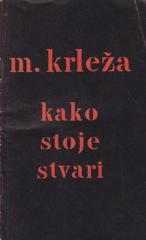
Kako stoje stvari: Predavanje održano u Domu JNA u Zagrebu 17. 12. 1952.

Kako stoje stvari: Predavanje održano u Domu JNA u Zagrebu 17. 12. 1952.

Miroslav Krleža

In his lecture How Things Are (1952), Krleža discusses the political and cultural situation of post-war Yugoslavia, emphasizing the need for critical thought, cultural renewal, and resistance to dogmatism.

Zora, 1953.
Croatian. Latin alphabet. Paperback.
12.48
Preko granica

Preko granica

Sveta Lukić
Svjetlost, 1984.
Croatian. Latin alphabet. Paperback.
3.99
Nesvrstani Blistok Rolović

Nesvrstani Blistok Rolović

Ante Kesić
August Cesarec, 1973.
Croatian. Latin alphabet. Paperback.
3.80