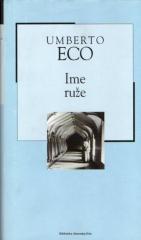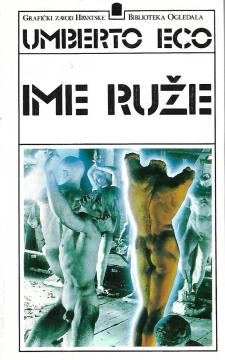
Ime ruže

Ime ruže

Umberto Eco

"The Name of the Rose", Umberto Eco's debut novel originally published in 1980, is an erudite crime novel, but also a brilliant book on medieval philosophy, history, theology and logic.

The story is told from the perspective of Adso of Melk, a young monk who accompanies the Sherlock Holmes-inspired Franciscan William of Baskerville to a monastery where they investigate a series of mysterious deaths. The monastery, a center of learning and culture, houses a valuable library, but also hides dark secrets. The deaths of the monks are linked to a mysterious book – Aristotle’s treatise on comedy – which provokes conflicts between the monks, the Inquisition and the church authorities.

William’s rational approach to research clashes with fanaticism and dogmatic attitudes, especially with the figure of Bernardo Gui, the inquisitor. Through complex dialogues, Eco discusses the conflict between reason and faith, freedom of thought and authority. The labyrinthine library symbolizes the search for knowledge, but also the danger of its suppression. The novel culminates in a tragic denouement, where the truth comes to light, but at great cost.

Eco masterfully combines erudition, suspense, and humor, creating a novel that is both an exciting mystery and a profound meditation on the human need for meaning.

Original title
Il nome della rosa
Translation
Morana Čale
Editor
Nenad Popović
Graphics design
Zoran Pavlović
Dimensions
20 x 12 cm
Pages
551
Publisher
Grafički zavod Hrvatske (GZH), Zagreb, 1984.
 
Latin alphabet. Hardcover with dust jacket.
Language: Croatian.

No copies available

The last copy was sold recently.
 

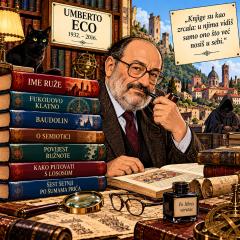
Are you interested in another book? You can search the offer using our search engine or browse books by category.

You may also be interested in these titles

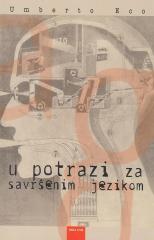
U potrazi za savršenim jezikom

U potrazi za savršenim jezikom

Umberto Eco
Hena Com, 2004.
Croatian. Latin alphabet. Hardcover with dust jacket.
17.26 - 17.36
Crna kutija

Crna kutija

Amos Oz

The Black Box is a kaleidoscope of married life and love relationships. It is a novel that implicitly speaks about all of us.

Hena Com, 2001.
Croatian. Latin alphabet. Hardcover.
10.98
Proces

Proces

Franz Kafka

Kafka wrote The Process between 1914 and 1915, published posthumously in 1925. The novel is unfinished but with an added final chapter by Max Brod. Edition with a foreword by B. Živojinović and an afterword by Walter Killi.

BIGZ, 1990.
Serbian. Latin alphabet. Paperback.
4.26
Stotina godina (antikronika)

Stotina godina (antikronika)

Dario Harjaček

The novel One Hundred Years by Dario Harjaček provides a panoramic view of Trešnjevka and its inhabitants through a century of changes, ideologies, and human destinies – a mosaic of Zagreb in which life, art, and history intertwine.

Oceanmore, 2025.
Croatian. Latin alphabet. Paperback.
13.42
Deobe 1-3

Deobe 1-3

Dobrica Ćosić

This work, awarded the NIN Prize for that year, is considered one of the most significant in Serbian literature after World War II.

Prosveta, 1961.
Serbian. Cyrillic alphabet. Hardcover with dust jacket.
The book consists of 3 volumes
11.42
Eva Luna

Eva Luna

Isabel Allende

Eva Luna is a novel about a poor storyteller who weaves lives with words, written by Isabel Allende, the founder of Latin American magical realism. Published after the success of The House of the Spirits, this whirlwind of adventure combines love, revolut

Znanje, 1990.
Croatian. Latin alphabet. Hardcover with dust jacket.
8.36