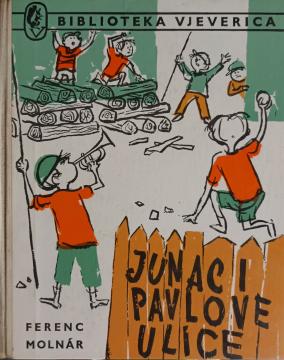
Junaci Pavlove ulice
Rare book

Junaci Pavlove ulice

Ferenc Molnar

A classic of Hungarian and world literature, exploring themes of friendship, loyalty, and growing up. Through vivid descriptions and emotional depth, Heroes of Paul's Street celebrates courage and solidarity, leaving a powerful impression on readers of al

Set in Budapest in the late 19th century, it follows a group of boys from Pavlova Street who defend their playground, the "grund", from a rival gang of Red Shirts. The grund is not just a place to play, but a symbol of freedom and a children's community.

The main character, Ernő Nemecsek, the smallest and weakest member of the gang, shows extraordinary courage and loyalty. Despite humiliations and health problems, Nemecsek sacrifices himself for his friends, participating in the crucial battle for the grund. The gang leader, János Boka, embodies wisdom and justice, while other boys, such as Čonaš and Geréb, face moral dilemmas and betrayal. Geréb, who crosses over to the Red Shirts, later seeks forgiveness, adding complexity to the relationships.

Molnár masterfully depicts the children's world as a microcosm of adult society, with rules, hierarchy and conflicts. The novel is imbued with nostalgia, but also tragedy, as Nemecsek's sacrifice and the loss of the grund to urbanization emphasize the transience of childhood.

Original title
A Pal-utcai fiuk
Translation
L. Matijević
Editor
Vera Barić
Illustrations
Ismet Voljevica
Graphics design
Ismet Voljevica
Dimensions
21 x 17 cm
Pages
213
Publisher
Mladost, Zagreb, 1989.
 
Latin alphabet. Hardcover.
Language: Croatian.
ISBN
8-60-500367-7

One copy is available

Condition:Used, excellent condition
 

Are you interested in another book? You can search the offer using our search engine or browse books by category.

You may also be interested in these titles

U Kordiljerima

U Kordiljerima

Karl May

In the Cordilleras (1894) is an adventure novel, a sequel to On the Rio de la Plata, part of May's South American cycle. The book follows adventures in Argentina during the revolutions, emphasizing themes of justice, forgiveness, and the struggle with the

Stvarnost, 1966.
Croatian. Latin alphabet. Hardcover.
7.32
Čiča Tomina koliba

Čiča Tomina koliba

Harriet Beecher Stowe

A novel that strongly depicts the cruelty of slavery in 19th century America and is one of the most influential works in the fight against slavery. The novel (1852) caused enormous social reactions and contributed to the strengthening of the abolitionist

Mladost, 1978.
Croatian. Latin alphabet. Hardcover.
2.24 - 5.38
Djetinjstvo

Djetinjstvo

Lav Nikolajevič Tolstoj

Childhood (1852) is the first book of an autobiographical trilogy (with Adolescence and Youth), where Tolstoy explores the world of childhood through the eyes of a ten-year-old boy, Nikolinka Irtenjev – innocence, joys, sorrows and first traumas.

Svjetlost, 1971.
Croatian. Latin alphabet. Hardcover.
6.54
Olfi među ženama

Olfi među ženama

Christine Nöstlinger

The novel humorously and warmly depicts the everyday life of a fourteen-year-old boy, Olfi (Wolfgang), the only man in a house full of women. A classic of Austrian children's literature, it is often read in elementary school.

Znanje, 2009.
Croatian. Latin alphabet. Paperback.
9.76 - 9.78
Princ Humorabi od Plusopotamije

Princ Humorabi od Plusopotamije

Ivan Balenović

A novel for children and young adults, written in the spirit of a fantastic epic and fairy tale with elements of humor, satire, and wisdom. The work was originally published in Serbian in 1992, and later translated and published in Croatian.

SysPrint, 2009.
Croatian. Latin alphabet. Paperback.
9.34
Kako smo lomili noge

Kako smo lomili noge

Miro Gavran

The novel How We Broke Our Legs (1997), a humorous and tender chronicle of family life through four decades of Croatian history, follows the fate of three generations of a Slavonian family from 1951 to 1992.

Mozaik knjiga, 2007.
Croatian. Latin alphabet. Paperback.
9.36