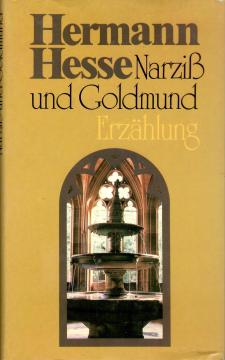
Narziß und Goldmund

Narziß und Goldmund

Hermann Hesse

In the novel Narcissus and Chrysostom, Hermann Hesse follows two friends: the ascetic monk Narcissus and the artistically restless Chrysostom, who search for the meaning of life through wanderings, love, and suffering.

Narcissus and Chrysostom is a novel by Hermann Hesse that explores the relationship between spirit and body, reason and emotion, asceticism and the passions of life. The plot begins in the medieval Mariabronn monastery, where two young men with completely different personalities meet. Narcissus is serious, thoughtful and devoted to the spiritual life. He believes in order, discipline, knowledge and service to God. Chrysostom, on the other hand, is sensitive, beautiful, instinctive and open to the world of the senses. Although his father sends him to a monastery to become a monk, Narcissus quickly recognizes that Chrysostom is not made for monastic life.

Their friendship becomes crucial for Chrysostom. Narcissus helps him realize that his true nature is not to be found in renunciation of the world, but in experience, love, art and contact with life. Chrysostom leaves the monastery** and sets off on a long journey. Along the way, he meets women, passion, beauty, death, illness and violence. His life becomes a series of powerful experiences, but also painful losses. Through encounters with people and through his own mistakes, he gradually matures and begins to understand the transience of everything earthly.

An important part of the novel is Chrysostom's discovery of his artistic calling. In a sculptor, he finds a teacher and realizes that he can shape what he has experienced. Art allows him to transform the experiences of love, motherhood, death, and longing into lasting forms. However, even art does not bring him complete peace. He remains torn between the desire for freedom and the need for meaning.

In the end, Chrysostom returns to Narcissus, now the abbot of the monastery. Their reunion shows that no path in life is complete in itself. Narcissus represents spirit, thought, and faith, and Chrysostom represents sensuality, creativity, and experience. The novel does not give a simple answer about which path is right, but rather depicts man as a being seeking a balance between opposing forces. Through the two of them, Hesse speaks about friendship, art, transience, and the need for everyone to find their own truth.

Dimensions
20.5 x 13 cm
Pages
334
Publisher
Suhrkamp Verlag, Berlin, 1971.
 
Latin alphabet. Hardcover with dust jacket.
Language: German.

One copy is available

Condition:Unused
 

Are you interested in another book? You can search the offer using our search engine or browse books by category.

You may also be interested in these titles

Igra staklenim perlama

Igra staklenim perlama

Hermann Hesse

The novel "The Glass Bead Game", published in 1943, is Hermann Hesse's greatest, almost life-long work, which he wrote for almost 12 years.

August Cesarec, 1987.
Croatian. Latin alphabet. Paperback.
8.32
Misli

Misli

Hermann Hesse

Thoughts is a collection of selected writings, aphorisms, and reflections by Hermann Hesse about man, life, art, love, nature, freedom, and spiritual development.

Zagrebačka naklada, 2003.
Croatian. Latin alphabet. Hardcover.
11.42
Hura, još živimo

Hura, još živimo

Johannes M. Simmel

The novel follows the life of Jakob Formann from 1946 to 1976: from a poor returnee from the war, through business ups and downs, love, marriages and scandals, to becoming one of the richest and most famous people in Germany.

Mladost, 1980.
Croatian. Latin alphabet. Hardcover with dust jacket.
6.484.86
Iskra života

Iskra života

Erich Maria Remarque

Spark of Life follows a group of inmates in a Nazi concentration camp who, despite the constant terror, retain their moral strength and humanity. The novel depicts the struggle of the spirit against systematic destruction and the need for hope.

Džepna knjiga, 1955.
Serbian. Latin alphabet. Paperback.
3.00 - 3.24
Fabian: Pripovijest o moralistu

Fabian: Pripovijest o moralistu

Erich Kästner

Jakob Fabian, an unemployed Germanist and moralist, wanders through Berlin in the 1930s, observing the moral, political and social decay and the rise of Nazism. He falls in love with Cornelia, but tragedies and nonsense lead him to a tragic end. Criticism

Mladost, 1952.
Croatian. Latin alphabet. Paperback.
5.32
Kaiserove kulije: roman njemačke ratne mornarice

Kaiserove kulije: roman njemačke ratne mornarice

Theodor Plievier

The Kaiser's Coolies (1930) is an anti-militarist novel by Theodor Plievier. Based on his own experience, it depicts the brutal life of ordinary sailors in the German navy during World War I and the sailors' mutiny of 1917.

Naklada Binoza, 1934.
Croatian. Latin alphabet. Hardcover with dust jacket.
5.26