Veronika Desinićka
Antikvitet
Rijetka knjiga

Veronika Desinićka

Josip Eugen Tomić

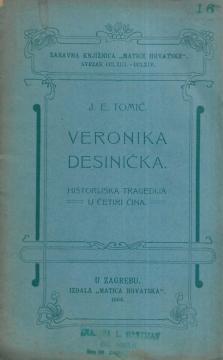
"Veronika of Desinić" by Josip Eugen Tomić, a historical tragedy in four acts, a drama about the tragic fate of Veronika of Desinić, the mistress and wife of Count Friedrich of Celje, accused of witchcraft and killed in 1425.

Veronika Desinićka by Josip Eugen Tomić was first published in 1904 in Zagreb by Matica Hrvatska. It is a historical tragedy in four acts, which deals with one of the most famous and saddest love stories of the Croatian Middle Ages.

The plot is based on real events from the 15th century. The main heroine is Veronika Desinićka (born in the village of Desinić in the Croatian Zagorje), a beautiful and proud girl from a lower class who won the heart of the powerful Count Friedrich of Celje. Their forbidden love ended tragically: she was accused of witchcraft and poisoning the Count's first wife. Veronika was captured, tortured and finally killed (drowned in a barrel) on the orders of Friedrich's father, Herman of Celje.

Tomić wrote the play in the spirit of romantic and national literature, emphasizing the conflict between love and power, class prejudices, political intrigue and fate. Veronika's innocence, beauty and courage in the face of the cruelty of the ruling nobility are particularly emphasized. The play is written in a harmonious, sublime language, with strong pathos and the effects of a typical historical tragedy.

Josip Eugen Tomić (1843–1906) was a prolific Croatian writer, novelist and playwright, known for his treatment of domestic historical material. Veronika Desinićka is considered one of his best dramatic works and represents a classic example of Croatian historical drama from the early 20th century.

The 1904 edition of Matica hrvatska is today a rare antiquarian copy, sought after among collectors of old Croatian drama and historical literature. The play was later reissued and performed several times, and the theme of Veronika Desinićka has remained a lasting inspiration in Croatian culture (literature, opera, film).

Dimenzije
21 x 13 cm
Broj strana
128
Nakladnik
Matica hrvatska, Zagreb, 1904.
 
Latinica. Broširano.
Jezik: Hrvatski.

Jedan primjerak je u ponudi

Stanje:Korišteno, u odličnom stanju
Specifičnost ovog primjerka:
Ex Libris
Dodano u košaricu!
 

Zanima Vas i neka druga knjiga? Možete pretražiti našu ponudu pomoću tražilice ili prelistati knjige po kategorijama.

Možda će Vas zanimati i ovi naslovi

Veronika Desinićka

Veronika Desinićka

Josip Eugen Tomić

"Veronika of Desinić" by Josip Eugen Tomić, a historical tragedy in four acts, a drama about the tragic fate of Veronika of Desinić, the mistress and wife of Count Friedrich of Celje, accused of witchcraft and killed in 1425.

Matica hrvatska, 1904.
Hrvatski. Latinica. Tvrde korice.
24,99
Melita

Melita

Josip Eugen Tomić
Matica hrvatska, 1964.
Hrvatski. Latinica. Tvrde korice.
4,993,74
Grešnik Lenart

Grešnik Lenart

Ivan Cankar

"Sinner Lenart" is a novella by Slovenian writer Ivan Cankar that deals with themes of redemption, moral dilemmas, and the inner struggle of the individual.

Spektar, 1974.
Hrvatski. Latinica. Tvrde korice.
2,86 - 3,26
Kuća lutaka

Kuća lutaka

Henrik Ibsen

A Doll's House (1879) by Norwegian playwright Henrik Ibsen is considered a masterpiece of realism and feminist literature. Set in 19th-century Norway, it follows Nora Helmer, the wife of banker Torvald.

Mozaik knjiga, 2004.
Hrvatski. Latinica. Tvrde korice.
11,32
Vuci

Vuci

Milutin Cihlar Nehajev

"Wolves" is a novel by Milutin Cihlar Nehajev that explores complex interpersonal relationships and moral dilemmas through the story of a wolf, a symbol of wilderness and freedom.

Spektar, 1974.
Hrvatski. Latinica. Tvrde korice.
2,68 - 3,76
Razbojnici

Razbojnici

Friedrich Schiller

A 1782 play by Friedrich Schiller, a key work of the Sturm und Drang movement. The plot revolves around the conflict between two brothers from the Moor family, Karl and Franz, and explores the themes of freedom, morality and social justice.

Europapress holding, 2008.
Hrvatski. Latinica. Tvrde korice.
5,32