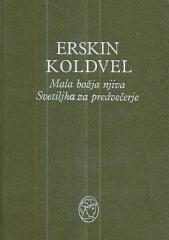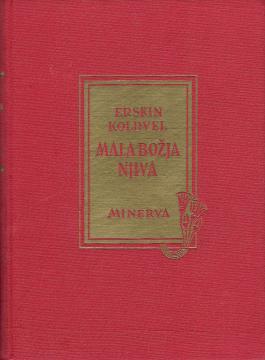
Mala božja njiva

Mala božja njiva

Erskine Caldwell

The impoverished Walden family in Georgia tear down their own land in search of buried gold. Obsessed with sex, greed, and illusion, they descend into a chaos of desire and violence during the Great Depression.

God's Little Field by Erskine Caldwell is a classic of American Southern Gothic and one of the most controversial and widely read works of the 20th century. Published in 1933, the novel brutally and honestly depicts the life of a poor white family in the southern United States during the Great Depression.

At the center of the story is the patriarch Ty Ty Walden, a possessed old man who, together with his sons, has been digging up the family farm for fifteen years in search of gold supposedly buried by his grandfather. Instead of cultivating the land, he turns it into a crater – a symbol of the futile pursuit of easy wealth. One small piece of land, "God's Little Field", he leaves untouched for the church, but moves it around as needed to suit his needs.

The novel is full of raw erotic tension, incestuous desires, adultery and violence. Caldwell does not embellish the characters – they are primitive, greedy, passionate and tragicomic. Through the story of the Waldens, the author paints a broader picture of the downfall of the rural South: a ruined country, unemployment, class conflicts in textile factories and moral breakdown.

Due to explicit scenes and social criticism, the book was banned and censored (most famously in Boston), but it became a huge bestseller with over ten million copies sold. Caldwell's style is direct, naturalistic and darkly humorous – a mixture of tragedy and grotesqueness reminiscent of his even more famous novel Tobacco Road.

Little God's Field is a powerful, provocative and uncomfortable novel that remains relevant as a critique of greed, false hopes and the decay of family and society. A must-read for fans of American literature, Southern Gothic, and writers like Faulkner, Steinbeck, and Tennessee Williams.

Original title
God's Little Acre
Translation
Bora Glišić
Editor
Tanasije Mladenović
Illustrations
Olivera Mitrašinović
Graphics design
Stevan Vujkov
Dimensions
20 x 14.5 cm
Pages
227
Publisher
Minerva, Subotica, 1958.
 
Latin alphabet. Hardcover.
Language: Serbian.

Two copies are available

Copy number 1

Condition:Unused

Copy number 2

Condition:Used, excellent condition
Damages or inconvenience notice:
  • Traces of patina
 

Are you interested in another book? You can search the offer using our search engine or browse books by category.

You may also be interested in these titles

Mala božja njiva, Svetiljka za predvečerje

Mala božja njiva, Svetiljka za predvečerje

Erskine Caldwell
Minerva, 1981.
Serbian. Latin alphabet. Hardcover.
4.99
Svetiljka za predvečerje

Svetiljka za predvečerje

Erskine Caldwell
Grafički zavod - Titograd, 1964.
Croatian. Latin alphabet. Paperback.
5.98
Mama, volim te

Mama, volim te

William Saroyan

Glavni likovi ovdje su majka, po zanimanju glumica, te njena kćerka. Krećući se u svijetu kazališta i umjetnosti, te radeći na predstavi mladog autora, one pronalaze put jedna prema drugoj.

Mladost, 1982.
Croatian. Latin alphabet. Hardcover.
6.12 - 6.26
Pravila za ljubav

Pravila za ljubav

Penelope Ward, Vi Keeland

Tipično za Ward i Keeland: emotivno, zabavno, s nezaobilaznim samohranim ocem, tinjajućim romansama, humorom, vrućim scenama i sretnim završetkom. Knjiga o suprotnostima koje se nadopunjuju i snagu ljubavi koja liječi rane.

Znanje, 2025.
Croatian. Latin alphabet. Paperback.
5.26
Oči Laure Mars

Oči Laure Mars

H. B. Gilmour

Modna fotografkinja Laura stječe slavu snimajući na ulicama metropole, gdje vladaju nasilje i kriminal, svoje ekskluzivne modele, pune erotskog naboja.

Grafički zavod Hrvatske (GZH), 1979.
Croatian. Latin alphabet. Hardcover with dust jacket.
3.96 - 4.12
Pustolovine Toma Sawyera

Pustolovine Toma Sawyera

Mark Twain

Pustolovine Toma Sawyera prvi je pravi realistički dječji roman, ne samo u američkoj nego i u svjetskoj dječjoj književnosti. Najpoznatije Twainovo djelo i omiljeno dječje štivo u kojem je pisac opisao svoje dječačke doživljaje.

Nakladni zavod Hrvatske, 1947.
Croatian. Latin alphabet. Hardcover.
16.32