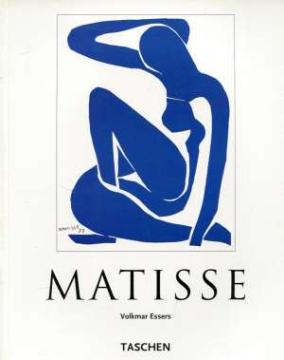
Velikani likovne umjetnosti #28: Henri Matisse - Majstor boje
Each book in Taschen's Basic Art series contains a detailed chronological summary of the artist's life and work, covering the artist's cultural and historical significance, approximately 100 color illustrations with explanations, and a brief biography.
Henri Matisse developed in the atmosphere of Neo-Impressionism, especially P. Signac, and the influence of P. Cézanne, P. Gauguin and V. van Gogh, and his painting was identical to that of the group of French Fauvist artists with whom he exhibited at the Salon des Indépendants in 1905. Matisse reduced each motif to its essential, precisely symbolic form, seemingly imposed, but in fact subtly simplified by a capricious arabesque line. He applied color in pure and airy tonalities in full chords of an open palette and rhythmically harmonized patterns. His frequent motifs are nudes or semi-nudes, odalisques in interiors with exotically ornamented draperies and carpets. Living mainly in southern France, he painted landscapes from Saint-Tropez and the area around Nice (Montalban, 1918). In the latter period of his life, he switched to the collage technique; he cut out sinuous figures from multi-colored paper, similar to fantastic leaves, and glued them into bizarre ornamental combinations. As a convert, he produced his last work, the project and designs for the interior decoration and furnishings of the chapel of Our Lady of the Holy Rosary in the village of Vence near Nice (1943–48, completed 1951). He produced monochrome and multi-color graphics, which had purely painterly values, and small sculptures (Little Head, 1906–07; Seated Nude, 1925). He illustrated works by Ch. Baudelaire, S. Mallarmé and J. Joyce, made ceramics and designed products of applied art (tapestry, glass, stained glass), set design and costumes for S. P. Diaghilev's Ballets Russes (I. Stravinsky, The Nightingale's Song, 1920). The Matisse Museum is located in his birthplace.
Više primjeraka je u ponudi