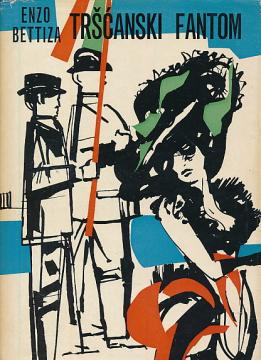
Tršćanski fantom

Tršćanski fantom

Enzo Bettiza

The novel follows Danijelo Solospino's growing up in Trieste before World War I. As he searches for his own identity, he confronts family relationships, love, and the clash of Italian and Slavic cultures.

The Phantom of Trieste by Enzo Bettiza is a psychological and socio-historical novel set in Trieste in the years before World War I. The main character Danijel Solospin is the last descendant of a distinguished Trieste family. He is withdrawn, sensitive and prone to reflection, and through his upbringing the author depicts the conflict between the world of childhood and the complex reality of adults.

Danijel loses his mother at an early age, while his father is carefree and more preoccupied with his own life than with raising his son. He is strongly influenced by his grandfather, a religious nanny from Drniš, and his family friend and physician Dr. Janovich, a broad-minded Slovene who introduces him to humanistic and democratic ideas. Important characters include Uncle Ugo, the painter Pfeffer, the Solospin brothers, and the Cossovel family, through whom Danijel learns about different views on life, art, and politics.

As he grows up, Danijel increasingly sees tensions between Italians and Slavs in Trieste. Although he feels Italian, he discovers that his family has Slavic roots, which causes him deep doubts about his own identity. At the same time, he goes through first loves, friendships and disappointments, and matures by facing social injustices and political conflicts.

Bettiza combines a psychological coming-of-age novel with a depiction of a city at the crossroads of cultures. Trieste is not only a place of action but also a symbol of encounters, conflicts and the intertwining of peoples. The novel conveys that personal identity cannot be built on national prejudices, but on understanding one's own roots and respecting diversity.

Original title
Il fantasma di trieste
Translation
Ante Rojnić
Editor
Danica Visković
Graphics design
Zlatko Prica
Dimensions
20 x 15 cm
Pages
412
Publisher
Naprijed, Zagreb, 1965.
 
Latin alphabet. Hardcover with dust jacket.
Language: Croatian.

One copy is available

Condition:Unused
 

Are you interested in another book? You can search the offer using our search engine or browse books by category.

You may also be interested in these titles

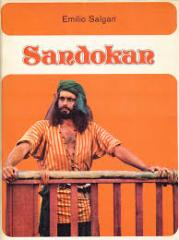
Sandokan

Sandokan

Emilio Salgari, Renato Caporali

A free prose adaptation by Renato Caporali based on the screenplay of the Italian mini-series Sandokan (1976, directed by Sergio Sollim, starring Kabir Bedi). It is based on the novel of the same name by Emilio Salgari (I pirati della Malesia, 1896).

Globus, 1977.
Croatian. Latin alphabet. Hardcover.
14.38 €
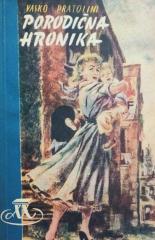
Porodična hronika

Porodična hronika

Vasco Pratolini

The book "Family Chronicle" by Vasco Pratolini is set in Florence, Italy, and follows the life of the Martini family during the period between the two world wars.

Džepna knjiga, 1956.
Croatian. Latin alphabet. Paperback.
2.76 €
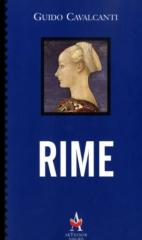
Rime

Rime

Guido Cavalcanti

Guido Cavalcanti's collection of Rime brings together love and philosophical poems from the early Italian dolce stil nuova. Through motifs of love, mind, and soul, Cavalcanti explores the conflict between reason and passion, and the transience of human fe

ArTresor naklada, 1998.
Croatian. Latin alphabet. Paperback.
9.32 €
Tupa bol

Tupa bol

Milena Agus

Milena Agus is an award-winning Italian writer. Tupa bol is a novel that brought her international fame, and it was also made into a movie directed by Nicole Garcia and starring Marion Cotillard.

Profil Knjiga, 2019.
Croatian. Latin alphabet. Paperback.
5.42 €
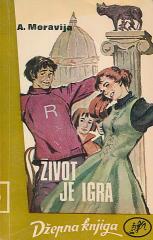
Život je igra

Život je igra

Moravia
Alberto Moravia

The book consists of several stories that explore the complexity of human behavior, often through an ironic and satirical depiction of everyday life.

Svjetlost, 1965.
Serbian. Latin alphabet. Paperback.
3.46 - 3.72 €
Rimske priče: izbor

Rimske priče: izbor

Moravia
Alberto Moravia

Collections of short stories from Roman life in the post-war era: ordinary people from the people and the petty bourgeoisie – the poor, workers, small craftsmen – face misery, survival, jealousy, petty deceit and moral compromises in everyday life.

Otokar Keršovani, 1966.
Croatian. Latin alphabet. Hardcover.
3.98 €