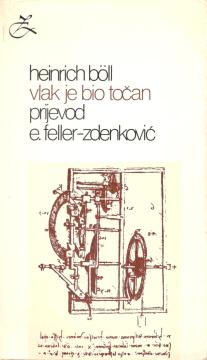
Vlak je bio točan

Vlak je bio točan

The first novel by Heinrich Böll. This work (1949) laid the foundation for Böll's later career, in which he continued to explore themes of moral responsibility and the consequences of war, which earned him the Nobel Prize for Literature in 1972.

The plot follows a young German soldier, Andreas, who travels by train to the Eastern Front in 1943, during the war. On the train, faced with imminent danger and the fear of death, Andreas undergoes a profound inner crisis. Through conversations with other soldiers and his own thoughts, the novel explores themes of the futility of war, the loss of hope, and the moral dilemmas of the individual in a totalitarian system.

Andreas's obsession with the punctuality of the train symbolizes the inevitability of fate and the dehumanizing nature of war. As the train progresses, his anxiety grows, and his premonition of his own death becomes stronger. The novel is characterized by its minimalist style, powerful psychological insights, and criticism of war, making it a key work of German post-war literature, the so-called Trümmerliteratur (ruin literature). Böll's focus on the character's inner world and his powerlessness in the face of historical forces reflects the experiences of a generation traumatized by the war.

Original title
Der Zug war pünktlich
Translation
Eva Feller-Zdenković
Editor
Vjeran Zuppa
Dimensions
19 x 11 cm
Pages
124
Publisher
Grafički zavod Hrvatske (GZH), Zagreb, 1981.
 
Latin alphabet. Paperback.
Language: Croatian.

One copy is available

Condition:Used, very good condition
Damages or inconvenience notice:
  • Library stamp
  • Underlined in pencil
 

Are you interested in another book? You can search the offer using our search engine or browse books by category.

You may also be interested in these titles

Begunac

Begunac

Lajos Zilahy

Lajoš Zilahi, Hungarian writer, left a deep mark in literature. His book "The Fugitive" from 1977 is one of his best works.

Bratstvo-Jedinstvo, 1977.
Serbian. Latin alphabet. Hardcover.
5.64
Posljednja konkubina

Posljednja konkubina

Lesley Downer

The year is 1861. Growing up deep in the mountains of Japan, Sachi has always felt different.

Oceanmore, 2009.
Croatian. Latin alphabet. Paperback.
11.96
Knjiga smijeha i zaborava

Knjiga smijeha i zaborava

Milan Kundera

The novel The Book of Laughter and Forgetfulness (1979), a fragmentary novel in seven parts, explores Czech history under the communist regime, particularly after the 1968 Prague Spring and the Soviet invasion.

Grafički zavod Hrvatske (GZH), 1982.
Croatian. Latin alphabet. Paperback.
9.36
Jahač nad jahačima

Jahač nad jahačima

Miodrag Bulatović

Miodrag Bulatović was a novelist and playwright, prone to dark, demonic visions. His picture of the world is morbid, and the characters are carnivalesque, grotesque and tragic at the same time.

BIGZ, 1983.
Serbian. Latin alphabet. Paperback.
5.98
Zaumlje

Zaumlje

Vasko Ivanović
Narodna knjiga, 1984.
Serbian. Latin alphabet. Paperback with dust jacket.
4.99
Tijela i duhovi

Tijela i duhovi

Mirko Božić

Bodies and spirits is the third part of the Kurlan trilogy by Mirko Božić, published in 1981, which follows the novels Kurlani (1952) and Neisplakani (1955).

Nakladni zavod Matice hrvatske, 1989.
Croatian. Latin alphabet. Hardcover.
5.24