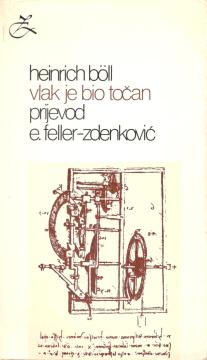
Vlak je bio točan

Vlak je bio točan

The first novel by Heinrich Böll. This work (1949) laid the foundation for Böll's later career, in which he continued to explore themes of moral responsibility and the consequences of war, which earned him the Nobel Prize for Literature in 1972.

The plot follows a young German soldier, Andreas, who travels by train to the Eastern Front in 1943, during the war. On the train, faced with imminent danger and the fear of death, Andreas undergoes a profound inner crisis. Through conversations with other soldiers and his own thoughts, the novel explores themes of the futility of war, the loss of hope, and the moral dilemmas of the individual in a totalitarian system.

Andreas's obsession with the punctuality of the train symbolizes the inevitability of fate and the dehumanizing nature of war. As the train progresses, his anxiety grows, and his premonition of his own death becomes stronger. The novel is characterized by its minimalist style, powerful psychological insights, and criticism of war, making it a key work of German post-war literature, the so-called Trümmerliteratur (ruin literature). Böll's focus on the character's inner world and his powerlessness in the face of historical forces reflects the experiences of a generation traumatized by the war.

Naslov originala
Der Zug war pünktlich
Prevod
Eva Feller-Zdenković
Urednik
Vjeran Zuppa
Dimenzije
19 x 11 cm
Broj strana
124
Izdavač
Grafički zavod Hrvatske (GZH), Zagreb, 1981.
 
Latinica. Broširano.
Jezik: Hrvatski.

Jedan primerak je u ponudi

Stanje:Korišćeno, u vrlo dobrom stanju
Oštećenja / nepogodnosti:
  • Underlined in pencil
  • Library stamp
Dodato u korpu!
 

Zanima Vas i neka druga knjiga? Možete pretražiti našu ponudu pomoću pretrage ili prelistati knjige po kategorijama.

Možda će Vas zanimati i ovi naslovi

Hiljadu ždralova

Hiljadu ždralova

Jasunari Kavabata

The tea ceremony, arranging flowers, arranging gardens and the art of creating beautiful porcelain stand in the background of this novel as symbols of the eternal and timeless in human creativity.

Dečje novine, 1989.
Hrvatski. Latinica. Broširano.
2,86
Hamsin 51

Hamsin 51

Dragan Velikić

The novel Hamsin 51 (1993) is one of Dragan Velikić's early highlights – a spectacular family saga and anti-war work written in the midst of the breakup of Yugoslavia, with an ending that will take place three decades later – in 2022.

PAIDEIA, 2012.
Srpski. Latinica. Broširano.
9,32
Iskre u tami

Iskre u tami

Mihajilo Radotić Glumac
RO Dragan Srnić, 1981.
Srpski. Latinica. Broširano.
5,86
Priče o braku i seksu

Priče o braku i seksu

Michal Viewegh

The book contains about twenty stories connected into one whole by the main character (the writer Oskar). It is, therefore, a kind of novel that, through intimate confessions, actually talks about the loneliness of the modern intellectual.

DiVič, 1999.
Hrvatski. Latinica. Tvrde korice.
7,46
Razmeđa

Razmeđa

Mirko Sabolović
Znanje, 1975.
Hrvatski. Latinica. Broširano.
2,99
Čiča Gorio

Čiča Gorio

Honore de Balzac

Uncle Goriot is the story of the old war profiteer Goriot and his daughters, who, after robbing him to the point of being naked, leave him to die in the solitude and misery of the Vaquer boarding house. It is a story that can be read today on several leve

Veselin Masleša, 1971.
Srpski. Latinica. Tvrde korice s omotom.
52,36 (komplet)