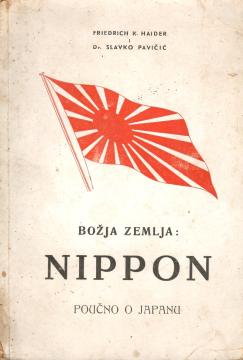
Božja zemlja Nippon: Poučno o Japanu
Retka knjiga
Antikvitet

Božja zemlja Nippon: Poučno o Japanu

Friedrich K. Haider, Slavko Pavičić

"God's Land Nippon" by Friedrich K. Haider and Slavko Pavičić is an educational book about Japan, its culture, history, customs and spirituality during World War II. Popular propaganda reading for the NDH.

The booklet is a popular and educational publication intended for a wider audience in the Independent State of Croatia. Slavko Pavičić (1885–1947), a Vinkovci publicist, military historian and editor of the Croatian Encyclopedia, is known for his works on military history. Friedrich K. Haider is probably the author of most of the content on Japan, while Pavičić participated in the preparation or addition of the text.

The book provides an overview of Japan as an exotic, highly disciplined and spiritually rich country – “God’s Land”. It describes Japanese history, Shintoism and Buddhism, the imperial cult, samurai tradition, customs, family life, art and warrior spirit. It particularly emphasizes Japanese loyalty to the emperor, national discipline, industry and willingness to sacrifice – topics that had a clear propaganda weight in the war year of 1942, because Japan was an ally of the Axis powers.

The style is simple, popular and accessible, with the aim of bringing the distant Asian power closer to the Croatian reader in a positive, almost idealized light. The book is part of a series of publications from the time of the Independent State of Croatia that represented the allied countries (Germany, Italy, Japan) in order to shape public opinion and strengthen awareness of the new world order.

The edition is a rare antiquarian copy and testimony to the publishing industry in wartime Zagreb. It reflects the political context of the time and the interest in Japan as the "miracle of Asia" – a modern industrial power that retained deep traditional roots.

God's Land Nippon is valuable as a historical document and as an example of how distant cultures were written about in Croatia in the 1940s – with a mixture of informativeness, admiration and ideological coloring. An interesting read for fans of old travel and popular-scientific literature, as well as those who study Croatian non-fiction of the Second World War.

Dimenzije
20 x 13,5 cm
Broj strana
63
Izdavač
Nakladna knjižara Velebit, Zagreb, 1942.
 
Latinica. Broširano.
Jezik: Hrvatski.

Jedan primerak je u ponudi

Stanje:Korišćeno, u vrlo dobrom stanju
Oštećenja / nepogodnosti:
  • Slight damage to the cover
Dodato u korpu!
 

Zanima Vas i neka druga knjiga? Možete pretražiti našu ponudu pomoću pretrage ili prelistati knjige po kategorijama.

Možda će Vas zanimati i ovi naslovi

Žene Italije

Žene Italije

Maria Castellani

An overview of the history and position of Italian women from antiquity to Mussolini's fascist Italy, with an emphasis on their contribution to society and culture. A popular educational publication from the period of the Independent State of Croatia, wit

Società Editrice di Novissima, 1941.
Hrvatski. Latinica. Broširano.
13,24
Doživljaji i putovanja do slobode

Doživljaji i putovanja do slobode

Vladimir Novak

The autobiographical work of Croatian communist activist Vladimir Novak, a survivor of the Ustasha camps, follows his memories of resistance to fascism during World War II.

August Cesarec, 1979.
Hrvatski. Latinica. Tvrde korice s omotom.
8,26
Zaraćeno poraće: Konfliktni i konkurentski narativi o stradanju i iseljavanju Talijana Istre

Zaraćeno poraće: Konfliktni i konkurentski narativi o stradanju i iseljavanju Talijana Istre

Franko Dota

The book analyzes how conflicting historical narratives about the suffering and mass emigration of Italians from Istria and Rijeka developed in Croatia and Italy after World War II (1943–1956), debunking myths and encouraging an empathetic approach to the

Srednja Europa, 2010.
Hrvatski. Latinica. Broširano.
11,32
Kazivanje o jednom pokoljenju: Knjiga druga

Kazivanje o jednom pokoljenju: Knjiga druga

Rodoljub Čolaković

Telling the Story of a Generation is a memoir trilogy by Rodoljub Čolaković that follows the path of Yugoslav communists between the two world wars, from emigration to the eve of World War II, through personal experience.

Naprijed, 1968.
Hrvatski. Latinica. Tvrde korice s omotom.
11,46
Komunisti Jugoslavije 1919-1979.

Komunisti Jugoslavije 1919-1979.

Pero Morača, Stanislav Stojanović

The book provides an overview of the history of the Communist Party of Yugoslavia (KPJ) from its founding to the late 1970s, emphasizing its role in the revolution, self-government, and construction of Yugoslavia, with an ideologically colored perspective

Eksportpres, 1979.
Srpski. Latinica. Tvrde korice s omotom.
11,98