O fenomenu Titove misli

O fenomenu Titove misli

Milan Dukić

Milan Dukić’s book *On the Phenomenon of Tito’s Thought* (1976) is a theoretical study. It analyzes the ideological, philosophical, and political influence of Josip Broz Tito on self-managing socialism and the doctrine of non-alignment.

The work On the Phenomenon of Tito’s Thought (O fenomenu Titove misli) by Milan Dukić, published in 1976 (by the publisher Stylos, Zagreb), presents a philosophical-theoretical and political-science analysis of the ideological legacy and political practice of Josip Broz Tito. Produced during a period of intensive theoretical systematization of the Yugoslav socialist model—following the adoption of the 1974 Constitution—this study seeks to shed light on the distinctiveness and originality of Tito’s thought within the broader framework of Marxist theory. The author approaches "Tito’s thought" as a dynamic social and theoretical phenomenon; it is not merely an adoption of dogmatic patterns, but rather a creative application of Marxism to the authentic historical and social circumstances of Yugoslavia. The book examines in detail the key tenets of Tito’s policy: the concept of workers' self-management as a foundation for the "withering away" of the state; the principle of "brotherhood and unity" within a multi-ethnic community; and the foreign policy doctrine and the Non-Aligned Movement. Through an analysis of Tito’s speeches, reports, and political decisions, Dukić aims to define the theoretical consistency and the vision that guided the Yugoslav path toward socialism. The book offers insight into the official ideological discourse of the latter half of the 1970s and serves as an important source for understanding how the political thought of the Yugoslav president was shaped and evaluated within the society of that time.

Editor
Milan Dukić
Graphics design
Šimo Klaić
Dimensions
20 x 14 cm
Pages
128
Publisher
Stylos, Zagreb, 1976.
 
Latin alphabet. Hardcover.
Language: Croatian.

One copy is available

Condition:Used, excellent condition
 

Are you interested in another book? You can search the offer using our search engine or browse books by category.

You may also be interested in these titles

Nauka o postanku čovjeka: Uvod u sociologiju

Nauka o postanku čovjeka: Uvod u sociologiju

Ljubomir Živković

A philosophical and sociological work by Ljubomir Živković, which is an introduction to sociology. The author discusses the origin and development of human society, the evolution of social forms, and the foundations of social science.

Hrvatska naklada, 1941.
Croatian. Latin alphabet. Paperback.
4.36 - 7.24 €
Essayi

Essayi

Natko Nodilo

The essays gather political, historical and cultural essays by Natko Nodil in which he discusses national identity, liberalism, religion and society, with an accompanying essay by Janko Koharić on the author's life and work.

Hrvatski štamparski zavod d.d., 1918.
Croatian. Latin alphabet. Hardcover.
11.32 €
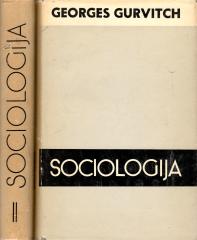
Sociologija I-II

Sociologija I-II

Georges Gurvitch

This seminal work by French sociologist Georges Gurvitch systematically presents the theoretical foundations, methods, and branches of sociology, defining social reality through deep-seated layers and total social phenomena.

Naprijed, 1966.
Croatian. Latin alphabet. Hardcover with dust jacket.
The book consists of two volumes
36.24 €
Manifest komunističke partije

Manifest komunističke partije

Marx, Engels
Karl Marx, Friedrich Engels

Marx and Engels’s foundational political text examines class struggle, capitalism and the working class, combining social criticism with a programme for revolutionary change.

Kultura, 1957.
Croatian. Latin alphabet. Paperback.
6.74 €
Prag: Kriza zapadne kulture

Prag: Kriza zapadne kulture

Thom Hartmann

Prague – The Crisis of Western Culture analyzes the causes of the social, political, and ecological crisis of the West and calls for a change in values ​​and the creation of a more just, sustainable, and humane society.

Dvostruka duga, 2011.
Croatian. Latin alphabet. Paperback.
12.64 €
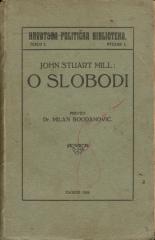
O slobodi

O slobodi

Mill
John Stuart Mill

The founder of modern liberalism, John Stuart Mill, in his essay "On Liberty" defends individual freedom from social and state pressure, setting limits on power over the individual and advocating freedom of thought, speech, and action.

Hrvatska tiskara, 1918.
Croatian. Latin alphabet. Paperback.
16.24 €