Zašto je Marx bio u pravu

Zašto je Marx bio u pravu

Terry Eagleton

With his exuberant and uncompromising critique of capitalism, Marx transformed our understanding of human history. Is Marxism, in the wake of today's devastating financial crisis, just a mere relic from another era?

In his polemical and controversial book "Why Marx Was Right", Terry Eagleton deals with the prejudice that Marxism is dead and done with. To glorify Karl Marx might seem as perverse as to stand up for the Boston Strangler. Weren't Marx's ideas responsible for despotism, mass murder, labor camps, economic disaster and the loss of freedom for millions of men and women? Wasn't one of his loyal followers a paranoid Georgian peasant named Stalin, and the other a brutal Chinese dictator who could easily have the blood of some thirty million members of his people on his hands? It is true, however, that Marx is responsible for the vast oppression of the communist world about as much as Jesus is responsible for the Inquisition. For one thing, Marx would scoff at the idea that socialism could take root in desperately impoverished, chronically backward societies like Russia and China.

In his analysis of each of these criticisms, Eagleton shows that they are just a miserable travesty of Marx's original thought. In a world where major crises have fundamentally shaken capitalism, the book "Why Marx Was Right" is as necessary and timely as it is bold and daring.

Written with Eagleton's typical sense of wit, humor and clarity, the book will appeal to a much wider readership than the classic academic audience.

Naslov originala
Why Marx Was Right
Prevod
Tonči Valentić
Urednik
Kristijan Vujičić
Naslovnica
Vesna Baranović
Dimenzije
21 x 14 cm
Broj strana
239
Izdavač
Naklada Ljevak, Zagreb, 2018.
 
Latinica. Broširano.
Jezik: Hrvatski.
ISBN
978-9-53355-188-3

Nema primeraka u ponudi

Poslednji primerak je nedavno prodat.


Zanima Vas i neka druga knjiga? Možete pretražiti našu ponudu pomoću pretrage ili prelistati knjige po kategorijama.

Možda će Vas zanimati i ovi naslovi

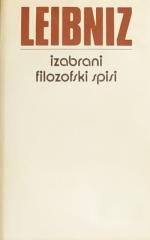
Izabrani filozofski spisi

Izabrani filozofski spisi

Gottfried Wilhelm Leibniz

The first comprehensive selection of Leibniz's philosophical works in the Croatian language. The selection does not include Theodicy and New Essays, as well as Leibniz's later scientific works.

Naprijed, 1980.
Hrvatski. Latinica. Tvrde korice s omotom.
18,32
Filozofija i smrt

Filozofija i smrt

Maja Milčinski

This work, along with various themes and problems of the Asian philosophical and religious schools, tries to show the acceptance of death as a part of life. The tradition of a cultivated relationship with death acts as a medicine and enables a positive re

CID-NOVA, 2008.
Hrvatski. Latinica. Broširano.
7,42
Nietzsche: Biografija njegove misli

Nietzsche: Biografija njegove misli

Rüdiger Safranski

Rüdiger Safranski, known for his works on Schopenhauer, Heidegger, and Goethe, presents an intimate "biography of thought" of Friedrich Nietzsche. The study traces the evolution of his ideas through key events, contradictions, and creative crises.

Sandorf, 2021.
Hrvatski. Latinica. Tvrde korice s omotom.
25,62
Rajski brežuljci: Povijest moći i nemoći

Rajski brežuljci: Povijest moći i nemoći

Mineke Schipper

In her book, Mineke Schipper explores cultures throughout history to describe the complex relationship men have with the female body. Despite the symbiotic relationship between the sexes, men have always had greater power than women, and at the root of it

Durieux, 2021.
Hrvatski. Latinica. Tvrde korice s omotom.
16,54
Rad panike

Rad panike

Goran Ferčec, Siniša Ilić

The work of panic by Goran Ferčec and Siniša Ilić is the first volume of the third round of the Friends library, a joint edition of MaMe and Books. Goran's text and Siniša's drawings were created as part of the production of the same name by the BADco gro

Multimedijalni institut, 2020.
Hrvatski. Latinica. Broširano.
8,42 - 9,56
Language and Liberty

Language and Liberty

Mária Schmidt
Public Endowment for Research on Central and Eastern European History and Society, 2018.
Engleski. Latinica. Tvrde korice.
8,42