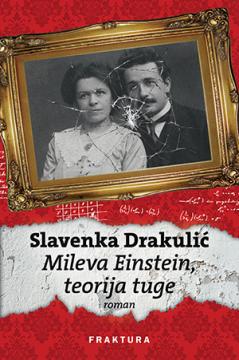
Mileva Einstein, teorija tuge

Mileva Einstein, teorija tuge

Slavenka Drakulić

In the novel "Mileva Einstein, Theory of Sorrow", Slavenka Drakulić brought the genius and his family to life. A palpable, real, full of life, but also depression, melancholy and love, Mileva appeared before the reader...

When, at the dawn of the First World War, she had just arrived in Berlin with her sons, where her husband, the most famous scientist of the twentieth century, Albert Einstein, had just received a job, she received a letter with the terms of their mutual life, Mileva Einstein's already fractured life was completely turned upside down. She remains alone, with two sons, with a huge burden of sadness that she carries inside her, with all the falls and breakdowns that she has had in her life and that she is yet to experience.

A person who was destined for the greatest scientific achievements, a genius mathematician, the first woman at the polytechnic faculty of the University of Zurich, always second and different, Mileva Einstein born Marić, from a rich family in Vojvodina, is almost paradigmatic in her destiny when we think about the position of women.

Her theory of grief is as difficult as any theory of relativity, but also much more common than it. The baggage of sadness that she carried from her earliest youth until her death, in which painful moments were only added over time, from children's limping and mocking, through love and a failed marriage with Albert, to the death of a child, a sick sister, unfinished college, a poor financial situation and serious illness of the youngest son, is a burden that every reader can understand.

Urednik
Seid Serdarević
Naslovnica
Maja Glušić
Dimenzije
21 x 14 cm
Broj strana
207
Izdavač
Fraktura, Zaprešić, 2017.
 
Latinica. Tvrde korice s omotom.
Jezik: Hrvatski.
ISBN
978-9-53266-814-8

Nema primeraka u ponudi

Poslednji primerak je nedavno prodat.

 

Zanima Vas i neka druga knjiga? Možete pretražiti našu ponudu pomoću pretrage ili prelistati knjige po kategorijama.

Možda će Vas zanimati i ovi naslovi

Mramorna koža

Mramorna koža

Slavenka Drakulić

Der in der ersten Person geschriebene Roman beschreibt die komplexe, distanzierte Beziehung zwischen einer Bildhauerin (der Erzählerin) und ihrer Mutter. Die Hauptfiguren sind die Bildhauerin, eine von Reinheit und körperlichen Makel besessene Schönheitsm

Grafički zavod Hrvatske (GZH), 1989.
Hrvatski. Latinica. Tvrde korice s omotom.
8,826,62
Život u pričama

Život u pričama

Ivana Bodrožić, Slavenka Drakulić, Rujana Jeger, Tisja Kljaković Braić, Maša Kolanović, Julijana ...

Starke Frauen für starke Frauen

Profil Knjiga, 2021.
Hrvatski. Latinica. Broširano.
6,22
O čemu ne govorimo

O čemu ne govorimo

Slavenka Drakulić

Können Sie sich den Tabus der modernen Gesellschaft stellen? Alter, Krankheit, Schwäche. Slavenka Drakulić wagt sich mutig an Themen heran, über die wir nur ungern sprechen.

Fraktura, 2024.
Hrvatski. Latinica. Tvrde korice s omotom.
14,62
Pariški maraton : Knjiga pisanja (Pariz21. i 22. oktobar 2023)

Pariški maraton : Knjiga pisanja (Pariz21. i 22. oktobar 2023)

Ende der achtziger Jahre reiste Damir Uzunović nach Paris und blieb dort weniger als ein Jahr. Er war damals zwanzig Jahre alt, und diese Zeit im Exil sollte prägend für sein späteres literarisches Schaffen sein.

Buybook, 2024.
Hrvatski. Latinica. Tvrde korice.
12,229,17
Stotina godina (antikronika)

Stotina godina (antikronika)

Dario Harjaček

The novel One Hundred Years by Dario Harjaček provides a panoramic view of Trešnjevka and its inhabitants through a century of changes, ideologies, and human destinies – a mosaic of Zagreb in which life, art, and history intertwine.

Oceanmore, 2025.
Hrvatski. Latinica. Broširano.
13,42
Proces

Proces

Franz Kafka

Kafka wrote The Process between 1914 and 1915, published posthumously in 1925. The novel is unfinished but with an added final chapter by Max Brod. Edition with a foreword by B. Živojinović and an afterword by Walter Killi.

BIGZ, 1990.
Srpski. Latinica. Broširano.
4,26