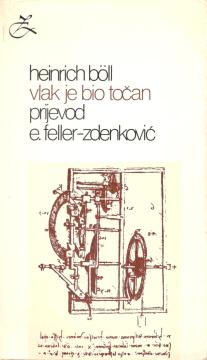
Vlak je bio točan

Vlak je bio točan

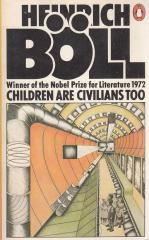
The first novel by Heinrich Böll. This work (1949) laid the foundation for Böll's later career, in which he continued to explore themes of moral responsibility and the consequences of war, which earned him the Nobel Prize for Literature in 1972.

The plot follows a young German soldier, Andreas, who travels by train to the Eastern Front in 1943, during the war. On the train, faced with imminent danger and the fear of death, Andreas undergoes a profound inner crisis. Through conversations with other soldiers and his own thoughts, the novel explores themes of the futility of war, the loss of hope, and the moral dilemmas of the individual in a totalitarian system.

Andreas's obsession with the punctuality of the train symbolizes the inevitability of fate and the dehumanizing nature of war. As the train progresses, his anxiety grows, and his premonition of his own death becomes stronger. The novel is characterized by its minimalist style, powerful psychological insights, and criticism of war, making it a key work of German post-war literature, the so-called Trümmerliteratur (ruin literature). Böll's focus on the character's inner world and his powerlessness in the face of historical forces reflects the experiences of a generation traumatized by the war.

Original title
Der Zug war pünktlich
Translation
Eva Feller-Zdenković
Editor
Vjeran Zuppa
Dimensions
19 x 11 cm
Pages
124
Publisher
Grafički zavod Hrvatske (GZH), Zagreb, 1981.
 
Latin alphabet. Paperback.
Language: Croatian.

One copy is available

Condition:Used, very good condition
Damages or inconvenience notice:
  • Library stamp
  • Underlined in pencil
 

Are you interested in another book? You can search the offer using our search engine or browse books by category.

You may also be interested in these titles

Na Drini ćuprija

Na Drini ćuprija

Ivo Andrić

Ivo Andrić's novel, published in 1945, is a masterpiece of world literature and winner of the Nobel Prize in 1961. Set in Višegrad, the story follows the history of the bridge over the Drina River from the 16th to the 20th centuries, built by Mehmed-paša

Svjetlost, 1988.
Serbian. Latin alphabet. Hardcover.
7.32
Sve zbog jednog dječaka

Sve zbog jednog dječaka

Nick Hornby

The cult novel All About a Boy is the story of Will, a thirty-six-year-old eternal boy who leads a completely carefree, atypical adult life, and of twelve-year-old Marcus, the child of recently divorced parents.

Algoritam, 2000.
Croatian. Latin alphabet. Paperback.
5.48
Jugoslavija, moja domovina

Jugoslavija, moja domovina

Goran Vojnović

Vladan grew up in Ljubljana convinced that his father, a former JNA officer, died at the beginning of the war. The only thing he remembers with nostalgia is growing up in Pula, because since they moved to Fužine, his mother and Vladan have become stranger

Fraktura, 2013.
Croatian. Latin alphabet. Hardcover with dust jacket.
11.968.97
Gola godina, Mećava

Gola godina, Mećava

Boris Piljnjak

The Naked Year, the novel with which Piljnjak gained fame at the age of 25, is one of the first fictional depictions of the Russian Civil War.

Europapress holding, 2010.
Croatian. Latin alphabet. Hardcover with dust jacket.
3.98
Kako je kasno bilo, kako kasno

Kako je kasno bilo, kako kasno

James Kelman

Regarding James Kelman's novel How Late It Was, How Late (1946), Janja Ciglar Žanić wrote in the Lexicon of Foreign Writers that it is a work of distinctive Beckettian mannerisms.

VBZ, 2002.
Croatian. Latin alphabet. Hardcover.
7.98
Veliki prljavi grad

Veliki prljavi grad

Ed Mcbain

In a big, dirty city, the detectives of the 87th Precinct are used to dealing with unusual secrets, ruthless criminals, and the dark side of human nature.

Zagrebačka naklada, 2001.
Croatian. Latin alphabet. Paperback.
3.98