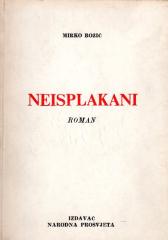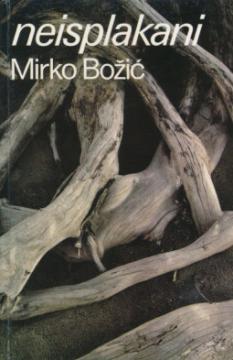
Neisplakani

Neisplakani

Mirko Božić

The second part of the Kurlan trilogy, set on the eve of World War II in the Cetinje region, follows Gara, a 16-year-old girl from Donje Kurlani. Pregnant from an affair with an unknown man, Gara faces social condemnation and patriarchal pressures.

Protected by her father Ćukan, who repels suitors and protects her from her brothers, Gara suffers in silence: she hides her pregnancy with a corset, avoids light, eats little and takes care of the cattle from dawn to dusk. Her inner restlessness ("a little worm in her head") forces her to introspect - she thinks about sin, motherhood and freedom.

The key event is a night escape through a hole in the roof that ends with her falling into a pit with liquid manure, a symbolic catharsis that "cleanses" her of suffering and initiates transformation. From a passive, oppressed child of the collective consciousness, Gara moves into an active fight for her destiny, confronting her body and soul. Comparisons with other women - the broken Perka, the sick Anđelija - highlight her strength, her "Kurlan nerve" (atavistic resilience).

Božić's raw dialect and dark humor depict rural isolation, where faith mixes with superstition, and war threatens. The novel explores emotional depths, class conflicts, and universal traumas.

Editor
Branimir Donat
Titelseite
Alfred Pal
Maße
20 x 13 cm
Seitenzahl
446
Verlag
Nakladni zavod Matice hrvatske, Zagreb, 1989.
 
Latein Schrift. Hardcover.
Sprache: Kroatisch.

Angeboten wird ein Exemplar

Zustand:Gebraucht, in ausgezeichnetem Zustand
Zum Warenkorb hinzugefügt!
 

Interessieren Sie sich für ein anderes Buch? Sie können das Angebot über unsere Suchmaschine suchen und finden oder Bücher nach Kategorien durchsuchen.

Diese Titel könnten Sie auch interessieren

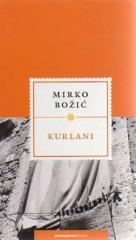
Kurlani: Gornji i Donji

Kurlani: Gornji i Donji

Mirko Božić

A post-war novel, the so-called native prose, published in 1952, a revised version dates from 1956, the first part of the "Kurlan trilogy" (followed by "Neisplakani", 1955 and "Tijela i duhovi", 1981) by the Croatian playwright, short story writer and nov

Večernji list, 2004.
Kroatisch. Latein Schrift. Fester Einband mit Schutzumschlag.
2,48 - 2,76
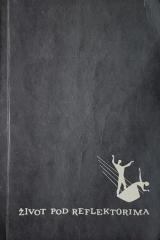
Život pod reflektorima: 7 suvremenih drama i komedija

Život pod reflektorima: 7 suvremenih drama i komedija

Mirko Božić, Pero Budak, Vladan Desnica, Fadil Hadžić, Ivica Ivanac, Marijan Matković, Duško Roks...
NIP, 1961.
Kroatisch. Latein Schrift. Fester Einband mit Schutzumschlag.
11,99
Neisplakani

Neisplakani

Mirko Božić
Narodna prosvjeta, 1961.
Kroatisch. Latein Schrift. Taschenbuch.
3,00
Andrićeva lestvica užasa

Andrićeva lestvica užasa

Svetislav Basara

A Serbian writer known for his satirical novels, Andrić's Ladder of Horrors dissects the Balkan mentality through a parable of Yugo-nostalgia and national myths. The title alludes to Ivo Andrić as a litmus test for criticism – Balkans claim him or reject

24 sata, 2021.
Serbisch. Latein Schrift. Taschenbuch.
11,56
Pariški maraton : Knjiga pisanja (Pariz21. i 22. oktobar 2023)

Pariški maraton : Knjiga pisanja (Pariz21. i 22. oktobar 2023)

At the end of the eighties, Damir Uzunović traveled to Paris and stayed there for less than a year. He was twenty years old at the time, and that exile episode would be formative for the literature he would later write.

Buybook, 2024.
Kroatisch. Latein Schrift. Hardcover.
12,22
Usta puna zemlje

Usta puna zemlje

Branimir Šćepanović

The novel "Usta puna zemlje" (1970), the masterpiece of the Serbian writer Branimir Šćepanović, is a psychologically in-depth explorer of the limits of the human soul, solitude and existential freedom, reminiscent of Kafka and Camus.

BIGZ, 1987.
Serbisch. Latein Schrift. Taschenbuch.
3,96 - 3,98