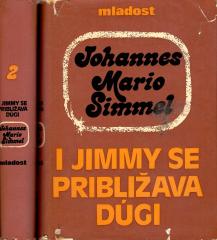
Hura, još živimo

Hura, još živimo

Johannes M. Simmel

The novel follows the life of Jakob Formann from 1946 to 1976: from a poor returnee from the war, through business ups and downs, love, marriages and scandals, to becoming one of the richest and most famous people in Germany.

Hurrah, we still live (1978) is one of the most popular novels by Johann Maria Simmel (1924–2009), an Austrian bestselling author known for his mixture of suspense, erotica, social satire and pacifism. This is a great family and social saga that follows three decades of post-war Germany through the life of the protagonist Jakob Formann.

Jakob returns from the war in 1946 poor, hungry and broken, but full of vitality and cynicism. He starts from scratch: he works illegally, engages in smuggling, enters into construction, advertising and media businesses. Thanks to cunning, charm and ruthlessness, he becomes a magnate - the owner of large companies, newspapers, TV companies. The novel depicts the German "economic miracle" (Wirtschaftswunder): a rapid rise from the ashes, but also moral compromises, corruption, suppression of the Nazi past and consumer hedonism.

Jakob's private life is turbulent: multiple marriages, mistresses, children, scandals. He is charismatic, restless, obsessed with sex and power, but also deeply unhappy - he carries the trauma of war, a guilty conscience and a sense of emptiness despite his wealth. Simmel uses Jakob's memories, dialogues and introspections to present a wider context: the reconstruction, the student riots of 1968, the Baader-Meinhof terrorism, changes in social morality.

The style is typical of Simmel: short chapters, a dynamic rhythm, lots of dialogue, eroticism and humor (often black). The novel is optimistic in its title ("Hurray, we still live!"), but critical of a society that has forgotten the lessons of war and lives in the illusion of prosperity.

Original title
Hurra, wir leben noch
Translation
Oto Šolc
Editor
Zvonimir Majdak
Graphics design
Fadil Vejzović
Dimensions
20 x 14 cm
Pages
657
Publisher
Mladost, Zagreb, 1980.
 
Latin alphabet. Hardcover with dust jacket.
Language: Croatian.

One copy is available

Condition:Used, excellent condition
 

Are you interested in another book? You can search the offer using our search engine or browse books by category.

You may also be interested in these titles

Dnevnik Anne Frank

Dnevnik Anne Frank

Anne Frank

Anne Frank died in March 1945 at the age of fifteen in the Bergen-Belsen concentration camp. Two years after that, the book The Diary of Anne Frank was published.

Marjan tisak, 2000.
Croatian. Latin alphabet. Paperback.
9.54
Smrt u Veneciji / Tonio Kröger

Smrt u Veneciji / Tonio Kröger

Thomas Mann

Death in Venice (1912) and Tonio Kröger (1903) by Thomas Mann are two novellas that explore the themes of art, passion, and the inner conflicts of the individual in the modern world.

Sveučilišna naklada Liber (SNL), 1979.
Croatian. Latin alphabet. Hardcover with dust jacket.
9.34
Marija Stuart

Marija Stuart

Stefan Zweig

Queen of Scotland at the age of six, in 1542, then Queen of France at the age of seventeen through her marriage to Francis II., Maria Stuart is one of the most romantic characters in history.

Naklada Binoza, 1937.
Croatian. Latin alphabet. Hardcover with dust jacket.
23.44
Des Sommers ganze Fülle: Roman

Des Sommers ganze Fülle: Roman

Laurie Lee

Childhood impressions and experiences of little Laurie in an isolated English village around 1920, still untouched by technical civilization.

dtv Verlagsgesellschaft, 1959.
German. Latin alphabet. Paperback.
5.464.10
Prodane djevojke

Prodane djevojke

Hedwig Courths-Mahler

A classic sentimental romance novel with motifs of inheritance, intrigue, class differences and happy love that overcomes obstacles. The main character is the young Rose Rietberg, a beautiful and noble girl who is orphaned at an early age.

Nakladni zavod Matice hrvatske, 1987.
Croatian. Latin alphabet. Hardcover with dust jacket.
6.98
Tri ratna druga

Tri ratna druga

Erich Maria Remarque

Three World War I comrades—Robbie, Otto, and Gottfried—try to survive in Weimar Germany in 1928. Amid economic crisis, poverty, and political violence, their friendship is their only refuge.

Minerva, 1954.
Serbian. Latin alphabet. Hardcover.
3.98