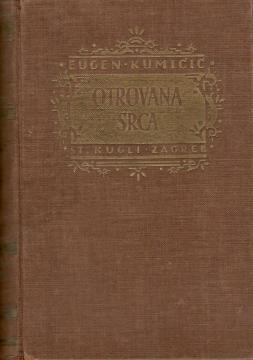
Otrovana srca / Pobijeljeni grobovi
One of the most prolific Croatian realists and early naturalists with a strong right-wing orientation, in this book he brings together two stories from the Zagreb bourgeois milieu: Poisoned Hearts (1890) and Whitened Graves (1896).
The St. Kugli publishing house published two socially critical stories in the Collected Works (vol. XI) of Eugen Kumičić (1850–1904): Poisoned Hearts (1890) and Whitened Graves (1896). Both belong to Kumičić's naturalistic-realist cycle dealing with the Zagreb bourgeois milieu.
Poisoned Hearts depicts salon intrigues, false loves, and marriages of convenience. At its center is the conflict between idealistic, honest characters and ruthless individuals who use deceit and manipulation for social advancement and material gain. The novel shows how “foreign” and degenerate elements poison pure hearts and destroy moral values in Croatian citizens.
Whitened Graves (the title taken from the Bible – beautiful on the outside, rotten on the inside) is an even harsher critique of hypocrisy. Kumičić exposes seemingly respectable Zagreb families and individuals who publicly cultivate an image of patriotism, faith and honesty, while privately being greedy, immoral and corrupt. The work naturalistically depicts false morality, salon intrigues and the decline of the bourgeois class under the influence of foreign interests.
Both stories bear a strong rightist stamp: Kumičić sees the causes of social ills in Germanization, Magyarization, opportunism and the lack of true national feeling. The characters are often schematically divided into positive (Croatian, idealistic) and negative (corrupt, foreign). The style is dynamic, rich in plot, sometimes melodramatic, with naturalistic details of everyday life and psychological portraits.
In the St. Kugli edition, the stories are illustrated and intended for a wider audience. They represent the pinnacle of Kumičić's social criticism, alongside novels such as Gospoda Sabina and Olga i Lina. Today they are valued as an important document on the moral and social conditions in Banska Croatia at the end of the 19th century, although critics often criticize them for their tendentiousness and black-and-white division of characters.
Jedan primerak je u ponudi
- The cover is missing